Private mortgage insurance, or PMI, ends on a date set by federal law. But the date is not the only way out. On many loans, a rising home value and a new appraisal can end it years early. This post counts the months to the legal dates, shows the home value you need for an early removal, and lists what to do if your servicer says no. To price PMI for your own loan, use the PMI calculator. This post does not repeat that math.
A worked example, with round numbers first
Start with a loan of $300,000. You are buying a home priced at about $333,333, and you put down 10 percent, which is about $33,333. The loan is a 30-year fixed loan at 7.40 percent. That rate is the Freddie Mac weekly average for the week of October 8, 2026, and it was unchanged on October 15.
Your loan-to-value ratio, or LTV, is the loan divided by the home's value. Here that is $300,000 divided by $333,333, which is 90 percent. A lower LTV means you own more of the home, so the insurer takes less risk. Your credit score tier is the range your credit score falls in, such as 760 and above. Insurers price in tiers, not in single scores.
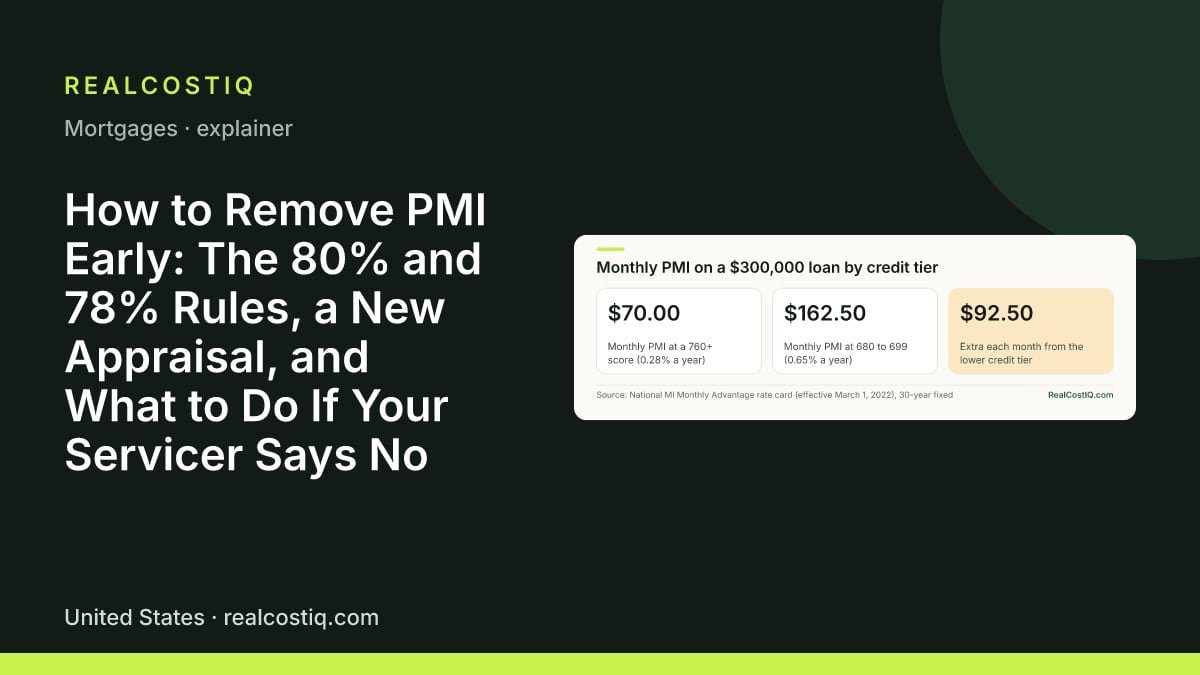
Now the formula, in words. Take the yearly PMI rate from the rate card. Multiply it by the loan amount. Divide by 12. That is the monthly PMI. The rate card used here is the one behind this site's PMI calculator. It comes from one insurer, National MI, and it was read again today. The rows below are the ones for a 90 percent LTV on a 30-year fixed loan.
| Step | 760 and above | 680 to 699 |
|---|---|---|
| Yearly rate from the card | 0.28% | 0.65% |
| Times the loan amount | $300,000 x 0.0028 = $840 | $300,000 x 0.0065 = $1,950 |
| Divide by 12 | $70.00 a month | $162.50 a month |
| Loan payment (principal and interest) | $2,077.14 | $2,077.14 |
| Monthly total | $2,147.14 | $2,239.64 |
Rates are from National MI's Monthly Advantage card for borrower-paid mortgage insurance, effective March 1, 2022, 30-year fixed, primary home, read October 16, 2026. The card is one insurer's price list, and it is more than four years old. Your quote will differ. The loan payment is the standard loan formula on $300,000 at 7.40 percent for 360 months.

The gap between the two columns is $92.50 a month, or $1,110 a year. The loan is the same. The home is the same. Only the credit tier changed. That is the main point about how PMI is calculated: the loan amount sets the base, and the credit tier and the LTV set the percentage.
Now the end date. Your loan payment stays at $2,077.14. Early on, most of it is interest. After payment number 105, which is 8 years and 9 months in, the loan balance is $266,593. That is below $266,667, which is 80 percent of the original value. After payment number 120, which is 10 years in, the balance is $259,808. That is below $260,000, which is 78 percent. So you can ask to end PMI after month 105, and the lender must end it after month 120.
| Credit tier | Monthly PMI | Total to month 105 (you ask) | Total to month 120 (automatic) |
|---|---|---|---|
| 760 and above | $70.00 | $7,350 | $8,400 |
| 680 to 699 | $162.50 | $17,063 | $19,500 |
Monthly PMI times the number of months. This assumes the premium stays level, as this site's PMI calculator does, and that you are current on payments. Premiums for months already used are not refunded.
Asking at month 105 instead of waiting for month 120 saves 15 payments. That is $1,050 at the 760 tier and $2,437.50 at the 680 to 699 tier. The rest of this post explains where each number comes from, and what can move the dates.
How the monthly PMI figure is set, in two sentences
An insurer sets a yearly rate from your credit tier, your loan-to-value ratio and the coverage level, and your servicer splits it into 12 payments. The PMI calculator walks through that math for your own numbers, so this post does not repeat the rate grid.
Who pays: borrower-paid and lender-paid
In the example the borrower pays PMI each month. That is called borrower-paid mortgage insurance. It is the common kind, and it is the kind the end dates below apply to. The CFPB says PMI can also be paid as one up-front premium at closing, or as a mix of both. Your Loan Estimate and Closing Disclosure show which one you have.
A second kind is lender-paid mortgage insurance. The lender buys the policy and charges a higher interest rate to cover it. There is no separate PMI line on your bill. The cost sits inside the rate. Under federal law (12 U.S.C. 4905), the lender must tell you before the loan that this kind may not be canceled by the borrower, and that it usually means a higher rate. Fannie Mae's Selling Guide says the lender must keep the coverage in force until the loan is paid in full. If you are comparing the two, ask for the rate with each and look at the total over the years you expect to keep the loan.
When PMI ends: the three dates in federal law
The Homeowners Protection Act of 1998 sets the end dates for borrower-paid PMI on most home loans that closed on or after July 29, 1999. The CFPB says it covers single-family homes that are your main home. FHA and VA loans follow different rules, and so does a loan where the lender pays for the insurance. All three dates use the original value of the home. The law defines that as the lower of the sales price or the appraised value when the loan closed. After a refinance, it is the appraised value at the refinance.
- You ask, at 80 percent. You can ask in writing once the balance is first scheduled to reach 80 percent of the original value. You can also ask sooner if extra payments bring the real balance to 80 percent. The servicer, which is the company that collects your payments, must cancel if you have a good payment history, you are current, you certify there is no second loan on the home, and the home has not lost value.
- It ends on its own, at 78 percent. The servicer must end PMI on the date the balance is scheduled to reach 78 percent of the original value. You do not have to ask. You must be current. If you are behind, PMI ends the first day of the month after you catch up.
- The midpoint, as a backstop. If neither date has come, PMI must end the month after the halfway point of the loan term. For a 30-year loan, that is after 15 years. You must be current. This rule matters most for loans with long interest-only stretches.
The statute calls the 80 percent date the cancellation date and the 78 percent date the termination date. Both are based on the original payment schedule, with one exception. For the 80 percent request, the law also lets you use the date your actual balance reaches 80 percent. A good payment history means no payment 60 days late in the 12 months that start 24 months before the date, and no payment 30 days late in the 12 months before it. The servicer must refund unearned premiums within 45 days.
Fannie Mae's servicing guide repeats these rules for its loans. It adds details. For a home you live in or a second home, the original-value request needs a value check. If today's value is below the original value, the servicer can say no. The guide asks for no payment 30 days or more late in the last 12 months, and none 60 days or more late in the last 24 months. The servicer cannot charge a fee for an automatic termination. For an investment property or a two-to-four-unit home you live in, the automatic date is the midpoint only, and the borrower request needs 70 percent.
Removing PMI early with a new appraisal: the 2-year and 5-year rules
The federal dates use the original value, so a home that has gained value does not help. Fannie Mae lets the servicer look at today's value on loans it owns. Fannie Mae's Servicing Guide (B-8.1-04, 05/15/2019, read 2026-10-21) sets the tests. Other investors write their own rules, so ask your servicer whose loan you have. I could not confirm a newer version of this section, so ask whether anything has changed.
| Property | Loan age | Loan-to-value on today's value |
|---|---|---|
| One-unit home you live in, or a second home | More than 2 and up to 5 years | 75% or less |
| One-unit home you live in, or a second home | More than 5 years | 80% or less |
| Same, when value-adding improvements waive the 2-year wait | Under 2 years | 80% or less |
| Investment property, or a two- to four-unit home you live in | More than 2 years | 70% or less |
Fannie Mae also requires a valuation based on an inspection of the interior and exterior. You must be current, with no payment 30 or more days late in the last 12 months and none 60 or more days late in the last 24 months. Repairs that keep the home in working order do not count as improvements. The servicer must not solicit you for this kind of removal, so you have to ask.
Here is what the tests mean in dollars. Take a $400,000 home bought with 10 percent down. The loan is $360,000 at 7.40 percent for 30 years. On the original schedule you can ask at month 105, and the servicer must end PMI at month 120.
| Request made at | Balance owed | Test | Home value needed | Rise from $400,000 |
|---|---|---|---|---|
| Month 36 (year 3) | $349,051 | 75% or less | $465,401 | 16.4% |
| Month 61 (just past year 5) | $339,889 | 80% or less | $424,861 | 6.2% |
Balance from the standard amortization schedule, scheduled payments only. Value needed = balance divided by 0.75 or 0.80. Computed 2026-10-21. The appraisal fee is your cost and is not included.
The wait matters more than the market. At year 3 the home would need to rise 16.4 percent. Just past year 5 it needs only 6.2 percent. If the value test is met at month 61, you skip 44 months of PMI against the month-105 date. Using the 2022 card rates from above on $360,000, PMI is $84.00 a month at 0.28 percent or $195.00 at 0.65 percent. Skipping 44 months saves $3,696 or $8,580 before the appraisal fee. If the fee is a few hundred dollars, the appraisal can pay for itself many times over. If values in your area are flat, it will not.
- Check the age and balance. Count the months since closing and find your balance on the latest statement.
- Estimate the value. Divide the balance by 0.75 or 0.80. If recent sales nearby sit above that number, an appraisal is worth ordering.
- Gather the proof. List any improvements that added value, such as an addition. Confirm you have no second mortgage or HELOC.
- Ask in writing. Ask the servicer what it needs and what the valuation costs before you agree to pay.
- Get the result in writing. If PMI ends, check that your next payment drops and that unearned premiums are refunded within 45 days.
If your servicer says no
Start by finding out which rule the servicer is using. A request at 80 percent of the original value falls under federal law. A request on current value falls under the investor's rules. The CFPB says that for a request at 80 percent the servicer is required to approve it if you have a good payment history, can certify there are no junior liens, and can show the value has not dropped below the original value (page last modified 08/31/2026, read 2026-10-21).
- Ask for the denial in writing, with the reason. On a Fannie Mae loan the servicer must send the reasons for denial, including the appraisal or broker price opinion result, within 30 days after the later of your request or the valuation.
- Match the reason to a fix. The usual reasons are a late payment in the lookback window, a second lien, a value below the test, a loan that is too young, or improvements with no proof. A late payment may only need time. A second lien may need to be paid off or released.
- Pay down the balance. Extra principal lowers the loan-to-value ratio, and the law lets you use your actual balance at 80 percent. See the extra-payments section below for the effect of $100 a month.
- Escalate in writing. Send a second letter to the servicer's written-notice address and cite the rule. The CFPB takes mortgage complaints at consumerfinance.gov/complaint. Its page says most companies respond within 15 days, and some take up to 60.
- Know your legal options. Under 12 U.S.C. 4907, a servicer that violates the Homeowners Protection Act is liable to the borrower for actual damages plus up to $2,000 in additional statutory damages in an individual action, and a court may add attorney fees. The suit must start within 2 years of discovering the violation. A consumer attorney can tell you if your case fits. This is not legal advice.
How many months until it ends? What moves the date
The end date is a loan-payment calculation, not an insurance one. It depends on how fast the balance falls. Three things speed it up: a bigger down payment, a lower rate, and extra payments. The tables below use the amortization schedule, which is the month-by-month list of how each payment splits into interest and principal. You can build your own with the amortization calculator.
| Down payment | Loan on a $400,000 home | Request at 80% (month) | Automatic at 78% (month) |
|---|---|---|---|
| 5% | $380,000 | 135 (11.3 years) | 147 (12.3 years) |
| 10% | $360,000 | 105 (8.8 years) | 120 (10.0 years) |
| 15% | $340,000 | 64 (5.3 years) | 84 (7.0 years) |
30-year fixed at 7.40 percent, scheduled payments only. The two marks are 80 percent and 78 percent of the original $400,000 value. At 20 percent down there is no PMI to end.
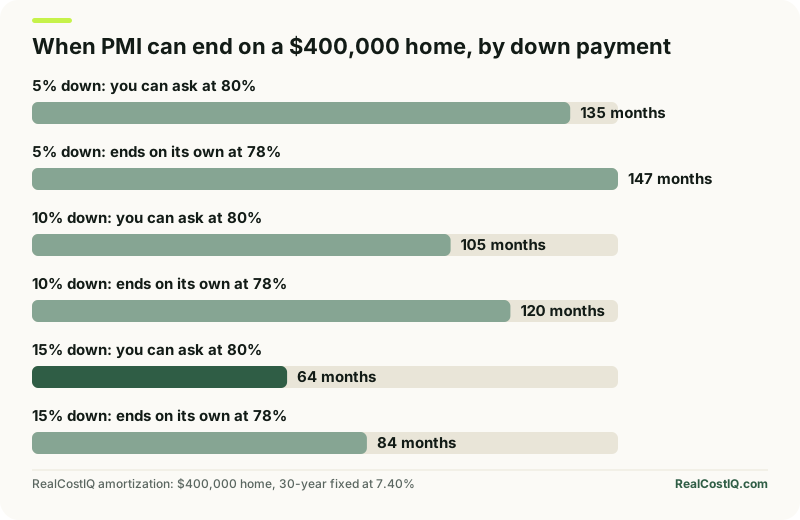
Look at the 5 percent row. At that down payment, the loan takes 11 years to reach 80 percent. The balance falls slowly at a high rate, because most of each early payment is interest. A lower rate speeds it up, but not by as much as many people expect.
| Rate | Loan payment | Request at 80% (month) | Automatic at 78% (month) |
|---|---|---|---|
| 5.50% | $1,703 | 84 (7.0 years) | 98 (8.2 years) |
| 6.50% | $1,896 | 95 (7.9 years) | 109 (9.1 years) |
| 7.40% | $2,077 | 105 (8.8 years) | 120 (10.0 years) |
The 5.50 percent and 6.50 percent rows are what-ifs, not forecasts. The 7.40 percent row is the Freddie Mac average for the week of October 8, 2026 (unchanged on October 15).
Two ways to end PMI sooner
Extra payments
Back to the $300,000 loan. If you add $100 a month toward principal, your real balance reaches 80 percent of the original value at month 80, not month 105. That is 25 months sooner. With $200 a month, it is month 64. The extra money is not lost. It goes into your equity, which is the part of the home you own. At the 680 to 699 tier, the 25 months you skip cost $4,062.50 in PMI at $162.50 a month. Tell your servicer in writing that the extra is for principal, and check that your next statement shows it.
Combining it with a new appraisal
Extra payments work on the legal 80 percent date. A new appraisal works on the investor's current-value test. The two combine, because extra principal lowers the balance and so lowers the value you need. The section above on removing PMI early with a new appraisal has the tests and the dollar example.
The cost of PMI compared with avoiding it
The CFPB lists three ways to avoid PMI. You can put 20 percent down. You can take a conventional loan with a smaller down payment that does not require PMI, though it usually carries a higher rate. Or you can use another loan type, such as an FHA loan, which has its own insurance rules. The last one can cost more or less depending on your case. One more route is a second loan that covers part of the down payment. A piggyback second loan is one such route. Each route has its own cost. This post only covers the PMI side.
PMI is also one line in a bigger monthly bill. Principal and interest, taxes, insurance and PMI together make up your payment. To run your own price, use the mortgage calculator for the loan payment and the PMI calculator for the insurance line.
How to check your own PMI, step by step
- Find the loan amount, rate and term on your Loan Estimate or Closing Disclosure. Find the PMI line and whether it is monthly, up front, or both.
- Find the original value. It is the lower of your sales price and the appraisal from closing.
- Multiply the original value by 0.80 and by 0.78. Those are your two target balances.
- Look at your amortization schedule, or build one, and find the first month when the balance is at or below each target. Your PMI disclosure form should also show the first date you can ask.
- Check that you are current on payments and have no second loan on the home. Ask your servicer in writing, and ask what they need.
- After PMI ends, check that your payment dropped and that any extra premium was refunded within 45 days.
None of this tells you to choose a lender, an insurer, or a down payment. It shows how the price and the end date are built, so you can read your own quote with the same steps.