You are moving. Your mortgage has a good rate, and a lot of time left on the term. The new home costs more, so you need a bigger loan. What do you do with the old mortgage? You have three choices. You can port it, which means your lender moves the rate and term to the new home. You can break it, pay the penalty and take a new mortgage at today's rate. Or you can port and borrow extra, which blends the old rate with the new one. This post works one example through all three, in Canadian dollars (CAD, shown as C$), and shows what the lenders say in public about how porting works.
A note on scope. We do not rebuild the penalty math here. The mortgage penalty calculator does that, and our guide on how the big banks calculate the interest rate differential explains the rules. Blend-and-extend, which lengthens your term, is covered in breaking a mortgage for a lower rate. This post is about the move itself: the window you have, the blended rate on the extra money, and the new approval you will face.
What porting is, and what lenders actually publish
The Financial Consumer Agency of Canada (FCAC), the federal consumer regulator, describes porting as taking your existing rate, terms and conditions with you to your new home, which saves you from breaking the contract and getting a new one. FCAC tells buyers to check with the lender early on whether it allows porting and to review the contract first. It also warns that a prepayment penalty can cost thousands of dollars. That is the whole of the regulator's advice. The detail lives in each lender's contract.
We read the public mortgage pages of four lenders on 2026-10-28. What they say is useful, and what they leave out is just as important.
| Lender | What the public page says | What it does not say |
|---|---|---|
| CIBC | Porting applies to all CIBC mortgages except the Variable Flex Mortgage. Four port types are set out: straight port, port and increase (blended rate), port and decrease (partial prepayment charge waived or reimbursed on the new balance), and delayed or reverse port (the new mortgage can be advanced up to 120 days before the old one is paid off). Variable Flex is replaced rather than ported, with a 120-day sell-and-buy window. | Fees, the exact approval criteria, and the rate formula for the extra money beyond "a similar term" |
| RBC | On a port increase you can borrow more, and "you will need to re-qualify". On a port decrease, normal prepayment rules apply. A processing fee covers the property valuation, your lawyer charges to register the new mortgage, and extra default-insurance premiums may apply. | A port window in days, and the blended-rate formula |
| Scotiabank | Porting transfers the rate and remaining term, with no prepayment charge. It is an option when you buy and sell at the same time. Eligibility depends on your mortgage agreement and the lender's requirements. | A window in days, blending, increase rules, and fees |
| Tangerine | If you move, you can take your mortgage with you at your current rate, term and loan amount. | Anything on deadlines, conditions, blending or fees |
Sources: CIBC "How to Port or Replace Your Mortgage", RBC "Mortgage Options for Your Next Home", Scotiabank "Should you stay or should you go?", and Tangerine's mortgage page, all read 2026-10-28. TD's public page we read covers only the prepayment charge, so we do not count it as a port source.
Look at that last column. Only CIBC publishes a window, and only for its own products. For the rest, the number of days between selling your old home and buying the new one sits in your mortgage commitment and the lender's standard terms. Search for it before you sign an offer, not after. We cannot give you a single "port window" for Canada, and a post that did would be guessing. What we can say with a source is that the CIBC figure is 120 days for a delayed port and for a Variable Flex replacement, and that CIBC allows 90 days to start drawing a construction loan after selling.
The worked example: port, break or port and increase
These are assumptions, not quotes. We use round numbers to show the mechanics. You owe C$420,000 on a five-year fixed mortgage at 3.49%. There are 30 months left on the term and 20 years left on the amortization. Your current payment is about C$2,428 a month. You are moving to a bigger home and need C$620,000, so you need C$200,000 of new money. We assume the lender's rate on a new fixed term of about 30 months is 4.59%. Fixed-rate Canadian mortgages compound twice a year, so we price them that way, using the same convention as our mortgage calculator. Check today's rates with your own lender. This is the working we show, not a rate we have seen offered.
Option A: port the C$420,000 and borrow the C$200,000 separately
Some lenders let you keep the old mortgage as it is and add a second piece at the new rate. The C$420,000 stays at 3.49% (C$2,428 a month). The C$200,000 at 4.59% over 20 years adds about C$1,270 a month. The total is about C$3,698 a month. A lender may not offer two pieces, and the two pieces may have different terms, which makes renewal messy. We show it as a cross-check on the blend.
Option B: port and increase, with a blended rate
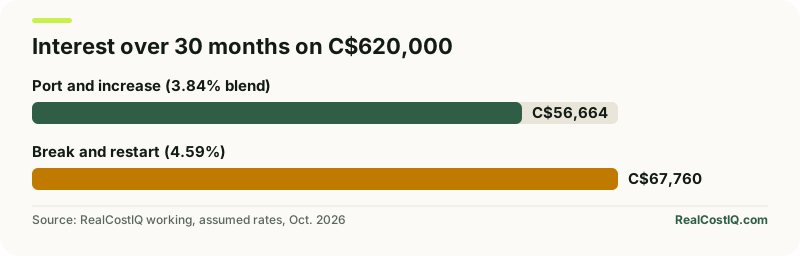
CIBC describes this as a blend of your original rate on the existing balance and its current rate for a similar term on the additional funds. The weighted average on our numbers is (C$420,000 x 3.49% + C$200,000 x 4.59%) / C$620,000, which is 3.84%. On C$620,000 over 20 years the payment is about C$3,697 a month. It is one loan, one rate and one payment, and it keeps your remaining 30-month term.
Option C: break the mortgage and start a new one
You pay the penalty on the C$420,000. If market rates have risen since you signed, as in our example, the interest rate differential (IRD) is usually zero and you pay three months of interest. TD's own page on prepayment charges describes the fixed-rate charge as the greater of three months' interest or the IRD. Three months on C$420,000 at 3.49% is about C$3,664. Then you take C$620,000 at 4.59%. The payment is about C$3,938 a month.
| Rate on C$620,000 | Monthly payment | Interest over next 30 months | Penalty | |
|---|---|---|---|---|
| Port and increase (blend) | 3.84% | C$3,697 | C$56,664 | None on the ported balance |
| Break and start new | 4.59% | C$3,938 | C$67,760 | About C$3,664 (3 months' interest) |
| Old mortgage only (for reference) | 3.49% on C$420,000 | C$2,428 | C$34,813 | n/a |
Our working. 20-year amortization remaining, semi-annual compounding, 30 months of interest. The break-and-restart penalty is three months of interest at 3.49% on C$420,000 and ignores any IRD. Rates are assumptions, not offers.
The blend costs C$241 a month less than breaking (C$3,938 less C$3,697), and the interest over the 30 months is C$11,096 lower (C$67,760 less C$56,664). Add the C$3,664 penalty you avoid, and porting and increasing is ahead by about C$14,760 across the term. That is the pattern when rates have risen since you signed. Your old rate is cheap money, and a blend lets you keep it on most of the loan. The gap is wider the bigger your old balance is compared with the new money.
Run your own numbers in the mortgage penalty calculator for the break side and the mortgage calculator for the payments. The one input we cannot give you is the rate the lender will put on the extra money. That is where lenders differ.
The rate on the new money is the catch
CIBC's page says the extra funds are priced at its current rate for a similar term. CIBC does not say whether that is its posted rate or a special rate, so it is not a promise of the lowest rate on offer. Posted rates and special "promotional" rates often differ, and a lender is free to price new money off either one. Ask for the rate in writing before you commit. If the new-money rate is far above what a competing lender would offer on a fresh mortgage, a blend can look good and still lose. Here is the test: compare the blended rate with the rate you would get from a fresh mortgage, and add the penalty to the fresh side.
When the blend is a poor deal, there is a fourth option. Keep the ported mortgage as a straight port and finance the shortfall elsewhere, for example with a second mortgage from the same lender priced separately. That gives the lender less room to blur the cost. A mortgage broker can get you several quotes in a day, and you will need them.
You have to qualify again for the increase
Porting is not an automatic right. RBC says in plain words that borrowing additional funds means you will need to re-qualify. The lender looks again at your income, debts and credit, and has the new home valued. Your old approval does not carry over just because the old rate does.
Whether the federal stress test applies to the new money is a lender call. The Office of the Superintendent of Financial Institutions (OSFI) says the minimum qualifying rate for uninsured mortgages is the greater of the mortgage contract rate plus 2% or 5.25% (page last modified 2026-01-29, read 2026-10-28). It says the rate applies to most newly underwritten residential mortgages. It does not apply to an uninsured straight switch at renewal, where you change lenders without raising the amount or the amortization. A port and increase is a change in the amount, so plan as if it is tested.
On our example, the blended rate of 3.84% plus 2% gives a qualifying rate of 5.84%. At that rate the payment on C$620,000 over 20 years is about C$4,362 a month, compared with the real payment of C$3,697. If you broke instead and took 4.59%, the qualifying rate would be 6.59% and the test payment about C$4,623. The blend is easier to pass, because a lower contract rate gives a lower test rate. That is a real, if small, advantage. See our stress test guide for how debt-service ratios turn those payments into a maximum loan.
The timing window and the gap between closings
Most moves do not close on the same day. If the old sale closes in July and the new purchase closes in September, you are in the gap. The question is whether the lender still lets you port. Scotiabank frames porting as an option when you buy a new property and sell the existing one at the same time. CIBC is the only one of the four to publish a number: a delayed or reverse port lets the new mortgage advance up to 120 days before the original is paid off, and CIBC says you may need bridge financing for the down payment or closing costs. Another lender may allow fewer days, or none. The contract rules.
Three things to do before you list the house:
- Ask your lender for the port window in days, in writing, and whether it counts from your sale closing or from your possession date.
- Ask whether your product can be ported at all. CIBC excludes its Variable Flex Mortgage from porting and replaces it instead. Other variable-rate products may have their own rules.
- Ask what happens if you miss the window. You then break the mortgage, and the penalty rules apply as in option C above.
Porting to a cheaper home: the decrease problem
Downsizing is where porting costs money. If the new mortgage is smaller than your old balance, you are paying off part of the loan early, and that part can attract a prepayment charge. RBC says normal prepayment rules apply on a port decrease. CIBC says a partial prepayment charge is waived or reimbursed based on the new mortgage balance, and the rate and term carry over. That wording matters: CIBC's rule shows the charge being treated as a partial one, not as a full break. FCAC makes the same point more generally. If your new home costs less than the amount of your mortgage, you may pay a prepayment penalty.
A rough size. If you port C$300,000 of a C$420,000 balance, the C$120,000 you do not carry over is the part at risk. Three months of interest at 3.49% on C$120,000 is about C$1,047. If the lender uses an IRD, the number can be higher when rates have fallen since you signed. Read your contract's prepayment section to see whether a partial prepayment is allowed free of charge up to some limit. Most contracts allow prepayment privileges of a set percentage each year, and a lump sum from the sale could use some of that.
CMHC insurance when you port and borrow more
If your old mortgage was insured by the Canada Mortgage and Housing Corporation (CMHC), and your new loan is also insured, portability can lower the premium. The CMHC premium page we read on 2026-10-28 lists a separate premium for the increase to the loan amount under portability. That premium is calculated at the rate on the total loan amount (less any premium credits) or on the increase, whichever is less. The table below shows the two columns.
| Loan-to-value on the new loan | Premium on total loan | Premium on the increase (portability) |
|---|---|---|
| Up to 65% | 0.60% | 0.60% |
| 65.01% to 75% | 1.70% | 5.90% |
| 75.01% to 80% | 2.40% | 6.05% |
| 80.01% to 85% | 2.80% | 6.20% |
| 85.01% to 90% | 3.10% | 6.25% |
| 90.01% to 95% | 4.00% | 6.30% |
Source: CMHC, Premium Information for Homeowner and Small Rental Loans, read 2026-10-28. CMHC also lists a 0.60% surcharge on the increase when a portability loan has a blended amortization. Lender and insurer rules decide whether you qualify for portability and any premium credit.
Here is how to read it. Say your new home costs C$700,000 and you take the C$620,000 loan from our example. That is an 88.6% loan-to-value ratio, so the 85.01% to 90% row applies. A fresh insured loan would carry 3.10% on C$620,000, which is C$19,220 before any other change. The portability route charges 6.25% only on the C$200,000 increase, which is C$12,500, and CMHC uses whichever of the two numbers is less. That is a C$6,720 difference on our example, before any premium credit. Your lender has to apply this for you, and many borrowers never ask. If your down payment is below 20% of the new price, ask. The CMHC insurance calculator shows the standard premium for comparison. These figures cover the insured case only. If your new loan is under 80% of the price, there is no default insurance to price.
A decision rule you can use
You do not need a spreadsheet. Work through four questions in order.
- Is your rate lower than what you would get today? If not, porting has no rate benefit, and a break can be cheaper once the penalty is small. The break-even maths is in our blend-and-extend and early renewal guide.
- Do you need more than you owe? If yes, you will be re-approved. Get the lender's blended rate in writing and compare it with a fresh quote plus the penalty.
- Will the two closing dates fall inside the lender's window? If you are not sure, ask for a longer one or line up bridge financing.
- Is the new loan smaller than the old balance? If yes, price the partial prepayment charge before you list.

Quebec, variable rates and other cases to check
A few cases change the answer. We flag them rather than guess, because the public pages we read do not settle them.
- Variable-rate mortgages. CIBC does not port its Variable Flex Mortgage at all and uses a replacement. A variable-rate prepayment charge is typically three months of interest (per TD's page), which is small. For many borrowers, breaking a variable mortgage costs little, so porting matters less.
- Moving to a rental or an unfinished home. CIBC's page says you can port to a property you already own that has no mortgage or line of credit. A new build has its own timing rules: CIBC allows 90 days to start drawing a construction loan after your sale and requires the new home to be complete within a year.
- Credit-union and monoline products. We did not read a credit union or monoline lender's terms for this post. If you have one, read the commitment letter. Do not assume it matches the banks.
- Land transfer tax. Porting does nothing to the tax on the new purchase. Each province sets its own, and Toronto and Montréal add a municipal layer. Use the land transfer tax calculator for the new home before you decide what you can afford.
What to do this week
Pull your mortgage contract and find three items: whether the mortgage is portable, how many days you have, and what the prepayment section says about a smaller loan. Then call the lender and ask for a written port-and-increase quote for the amount you expect to borrow. Ask for the rate on the new money, the fees (RBC lists a processing fee covering valuation, legal fees and possible insurance premiums), and the penalty if you miss the window. Compare it with one fresh quote from another lender, and add your penalty to that side. That is the whole decision. The rest is paperwork.
Two warnings. First, none of this is a rate quote. We used assumed rates to show the mechanics, and your lender's rates will differ. Second, lenders can change their terms, and our table shows pages read on one day. Confirm everything against your own contract.