You signed a five-year fixed mortgage with a big bank. Your banker said you got a good discount. Now you want to sell, refinance or switch. The bank quotes a penalty that looks too high. A broker tells you a smaller lender would have charged half as much. Is that true? And where did the bank find that number?
The answer sits in each bank's own published wording. This post reads that wording for TD, RBC, Scotiabank, BMO and CIBC, all read on 27 October 2026. It shows what is the same, what is different, and where to look for your own discount. It does not teach the break-or-wait decision. For that, see our post on breaking a mortgage for a lower rate. It also does not cover the five-year cap on long terms. That is in our post on section 10 of the Interest Act.
The rule all five banks share
Start with the part that is the same. Every bank in this post says the same thing for a fixed-rate closed mortgage. A closed mortgage is one where you cannot pay it all off early for free. If you break it, the charge is the greater of two amounts. The first is three months of interest. The second is the IRD.
Three months of interest is easy. Take your balance, multiply by your rate, and divide by four. On C$100,000 at 5.00%, that is C$100,000 x 0.05 / 4, or C$1,250. BMO and Scotiabank both print that exact shortcut in their own leaflets. RBC does it in days: balance x rate x 90 / 365. For variable-rate mortgages, TD, RBC, Scotiabank and BMO say the charge is three months of interest and nothing more, so there is no IRD to decode.
The IRD is where the banks differ in the fine print. The idea is the same. The bank asks: what rate would I charge for a new loan that matches the time you have left? It then compares that rate with yours. The gap, times your balance, times the time left, is the IRD. The next table sets out the five wordings side by side.
| Bank | What it compares your rate to | Where it tells you the discount lives | Document and date |
|---|---|---|---|
| TD | The posted rate for a similar mortgage, minus any rate discount you received | Its calculator defines the discount against TD's posted rate for the term you chose at signing | TD Explains: What is an IRD? (19 Aug 2020); TD prepayment calculator page |
| RBC | The posted rate for the remaining term, less any discount it gave you | Set out in your RBC Approval of Mortgage and Cost of Borrowing Statement of Disclosure | RBC form 310102 (May 2024, for former HSBC Canada borrowers); RBC prepayment example page |
| Scotiabank | The “Current Interest Rate” (its posted rate for the closest term), less the discount you received | Not said in the leaflet; its example states the posted rate at the start of the term | Scotiabank form 1343814 (July 2018) |
| BMO | Its current posted rate for the closest term, reduced by any discount; it calls this the comparison rate | Contact your branch or mortgage specialist to find your discount | BMO form 5008728 (June 2023) |
| CIBC | Interest at your rate plus any discount, against interest at the posted rate of the comparison mortgage in your documents | The comparison mortgage is “identified in your mortgage documents”; the page does not say where the discount sits | CIBC prepayment page (undated) |
Wording is summarized; short phrases are quoted in the sections below. Your own mortgage contract is the legal source, and each bank says so.
One loan, four discounts: what the discount does to the charge
Here is a round-number example. You owe C$100,000 on a fixed mortgage at 5.00%. You have 36 months left. You want to pay it off in full. The numbers below are made up to show the method. They are not any bank's real posted rates.
Assume the bank's posted rate for a three-year mortgage is 5.50% on the day you leave, and use the simple estimate the banks print: gap x balance x months left / 12. Our mortgage penalty calculator walks through the full method.
Now keep the 5.00% rate and the C$100,000 the same. Change only the discount. The table shows what happens.
| Discount you got at signing | Comparison rate (5.50% less discount) | Gap to your 5.00% rate | Simple IRD estimate | Three months of interest | Estimated charge |
|---|---|---|---|---|---|
| 0.50 point | 5.00% | 0.00 point | C$0 | C$1,250 | C$1,250 |
| 1.00 point | 4.50% | 0.50 point | C$1,500 | C$1,250 | C$1,500 |
| 1.50 points | 4.00% | 1.00 point | C$3,000 | C$1,250 | C$3,000 |
| 2.00 points | 3.50% | 1.50 points | C$4,500 | C$1,250 | C$4,500 |
Estimate = gap x balance x months left / 12, the shortcut RBC, Scotiabank and BMO print in their own examples. The banks say their exact formulas give a lower number. Legal, discharge and other fees are extra. The posted rates are invented for the example.
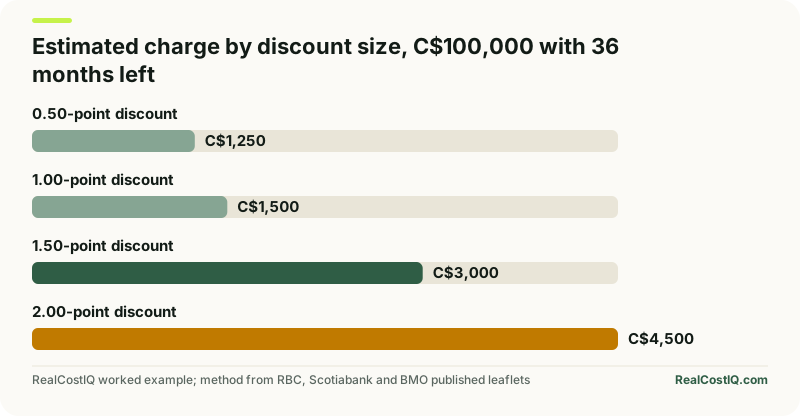
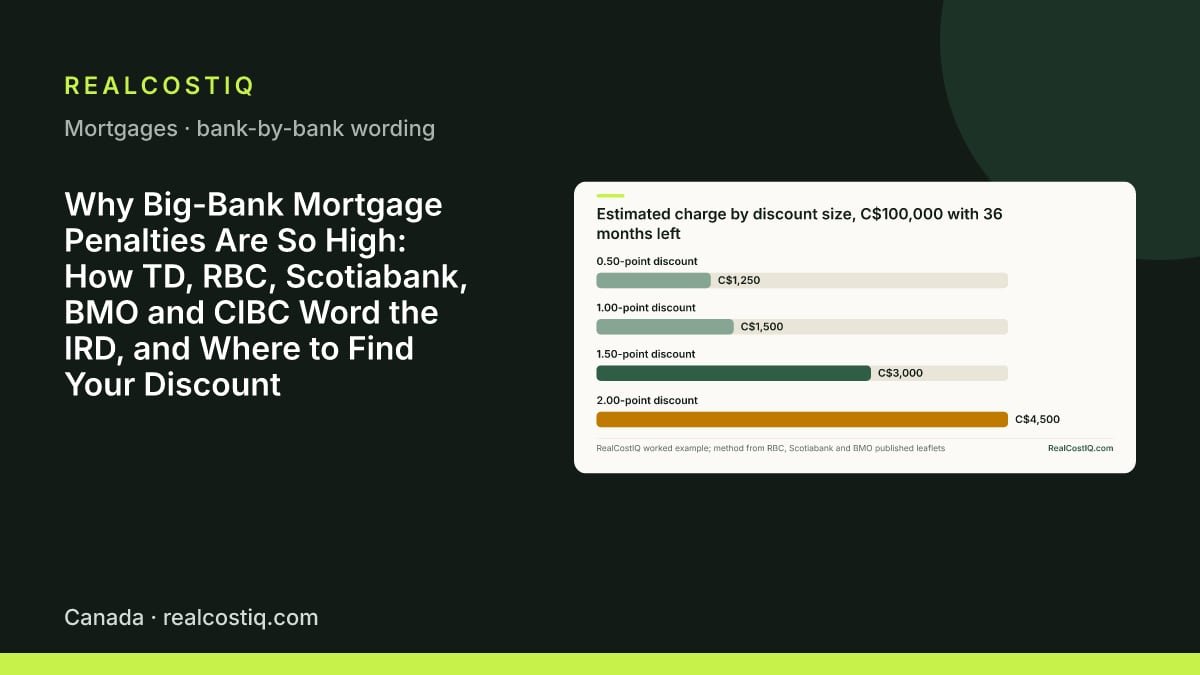
The same C$100,000 loan can cost C$1,250 or C$4,500 to leave, with nothing changed but the discount. Why? Because your rate plus your discount equals the bank's posted rate on the day you signed. So the IRD is really the drop in the bank's posted rates since signing day. A big discount means the posted rate was far above your rate on signing day. The penalty formula then credits you only with the posted rate today. It gives you no credit for the discount you worked for.
CIBC states it this way. Its page compares interest at your current rate plus any discount you received with interest at its current posted rate. BMO, RBC, TD and Scotiabank state it the other way round, as your rate minus the posted rate less your discount. The two forms give the same answer. The CIBC wording just makes the point easier to see.
How each bank words it
TD
TD's explainer, published 19 August 2020, says a fixed-rate closed mortgage costs the higher of three months of interest or the IRD. It says the similar mortgage rate is the posted rate for a similar mortgage, “minus any rate discount you received.” It adds that the three-month figure is worked out over 90 days on the amount you prepay, at your annual rate. The explainer gives no example numbers.
TD's prepayment calculator page fills in two terms. It says a similar mortgage is one TD offers today with a term closest to the time you have left. It points to your discount through TD's posted rate for the term you chose when you took the mortgage. The page also says the calculator gives an estimate only. Your actual charge may be higher or lower.
RBC
RBC gives the most detail, but read this carefully. Form 310102, dated May 2024, is an amending agreement for borrowers who applied to the former HSBC Bank Canada and were moved to RBC. It is not RBC's general mortgage terms. It states the IRD as a formula. The charge is the prepayment amount, times your rate less (posted rate less discount), times the days left, divided by 365. RBC says it uses the stated rates and does not adjust for compounding or a leap year. For three months it uses 90 days of interest, not a quarter of a year.
RBC also prints a chart that picks the posted-rate term from the days left. For example, 1,096 to 1,460 days uses the four-year fixed rate. That chart matters, and the next section shows why. The consumer example page, which is undated, uses a 9% rate, 36 months left and a 0.5% discount. It gets a C$10,500 estimate against C$2,250 of three-month interest. It warns that RBC uses “a more complex calculation that will result in a lower charge.”
Scotiabank
Scotiabank's leaflet (form 1343814, dated July 2018, so the oldest paper in this post) splits the test into two parts. Part A is three months of interest. Part B is the IRD. The IRD is a present-value comparison. That means it adds up all the interest from the day you leave to maturity at your rate, then does the same at the Current Interest Rate less your discount, and takes the difference.
It defines the Current Interest Rate as its posted rate for a new fixed closed mortgage with a term closest to what you have left. If you are exactly halfway between two terms, it rounds up. It counts the months left rounded up to the next whole month. Its worked example has a 9% rate, a 0.5% discount, 36 months left and C$100,000. The simple estimate is C$9,000 against C$2,250 for three months. It then says the exact IRD amount “would be lower than the amount estimated above.”
BMO
BMO's leaflet (form 5008728, June 2023) is the only one of the five that names the comparison rate. It describes your rate against its current posted rate for a similar mortgage, “reduced by any rate discount you may have received (also known as the comparison rate).” It gives the formula as IRD = your rate less (posted rate less discount). It then estimates the charge as IRD x amount x months left / 12.
Its example: 6.30% rate, 6.50% posted rate for four years, a 2.00-point discount, C$99,008 prepaid, 53 months left. The comparison rate is 4.50%. The gap is 1.80 points. The estimate is C$7,871.12 against C$1,559.37 of three-month interest. BMO adds two rules that others do not spell out in the same place. If the IRD works out to zero or less, the charge is three months of interest. In the last three months of the term, the charge is the interest from the day you leave to the end of the term.
CIBC
CIBC's page uses dollars, not a rate shortcut. Its example is C$100,000 with 24 months left, a 6.50% rate and a 0.50% discount. Interest over the 24 months at 7.00% is C$13,603.92. At the 5.00% posted rate, it is C$9,567.59. The IRD is the difference, C$4,036.33. Three months of interest is C$1,749.99. So the charge is C$4,036.33.
The page ties the posted rate to “the comparison mortgage identified in your mortgage documents.” That puts the answer to “which posted rate?” in your own paperwork. The page has no date. It carries a footnote about mortgages that began before April 2026, and we did not work out what changes for newer ones. Check which version your mortgage follows.
Same words, different term: which posted rate you get
All five banks say they match your time left to a posted-rate term. But the way they round differs, at least on paper. BMO gives its own example. With 44 months left it uses the four-year rate. With 40 months left it uses the three-year rate, because three years is the closest term. Scotiabank says closest, and rounds up at an exact tie. RBC uses a chart of day ranges. A chart like that always rounds up. It does not look for the nearest term.
| Months left | RBC (day chart) | Scotiabank (closest; tie rounds up) | BMO (closest) |
|---|---|---|---|
| 37 (about 1,125 days) | 4-year | 3-year | 3-year |
| 40 (about 1,217 days) | 4-year | 3-year | 3-year |
| 42 (about 1,278 days) | 4-year | 4-year (exact tie) | Closest; no tie rule stated in the leaflet |
| 47 (about 1,430 days) | 4-year | 4-year | 4-year |
| 49 (about 1,490 days) | 5-year | 4-year | 4-year |
Read from RBC form 310102 (May 2024, former HSBC Canada borrowers only), Scotiabank form 1343814 (July 2018) and BMO form 5008728 (June 2023). TD's calculator page says closest term; CIBC points to the comparison mortgage in your documents. Banks may have updated their rules since these papers; ask for the term used on your quote.
Why care? A different term can mean a different posted rate. If the four-year posted rate is higher than the three-year one, RBC's chart would give a higher comparison rate at 37 months than BMO's rule would. A higher comparison rate means a smaller gap and a smaller IRD. If the curve slopes the other way, the effect flips. We do not know today's posted rates, so we cannot say which way it cuts. The point is practical. When you ask for a quote, ask which posted-rate term the bank used and what that rate was.
Timing matters too. BMO says the charge can change if you prepay on a different date than the one you asked about. The remaining term, the posted rate and the amount all move. A quote is for a date. Ask for a new one if your date changes.
Why the estimate on the page is higher than your bill
Three of the banks say it outright. Their shortcut formulas overstate the charge. RBC says its own calculation “will result in a lower charge.” Scotiabank says the exact IRD would be lower than its estimate. BMO says the actual IRD charge with the same inputs would be lower, because its formula gives credit for the fact that the bank gets the money now instead of over the term.
Think of it this way. The shortcut multiplies the rate gap by the full balance for the full time left. But if you keep the mortgage, you pay down the balance month by month. The bank would not earn on the whole balance all the way to maturity. The exact method accounts for that. So the shortcut is a ceiling you can use for planning. It is not the bill.
Do not read this as good news without checking. TD says its calculator estimate may be higher or lower than the real figure. CIBC tells you to order a payout statement for the exact amount. Treat any online number as a range, and get the final figure in writing.
Where to find your discount
The discount is the number the whole formula leans on. Here is what each bank's paper says about where it sits. Only RBC's paper names the document. For the others, the page we read does not.
- RBC: your rate and the discount are “set out in” your RBC Approval of Mortgage and Cost of Borrowing Statement of Disclosure, or your Homeline Plan Agreement (form 310102, May 2024; this form is for former HSBC Canada borrowers, so check your own RBC paperwork).
- BMO: its leaflet tells you to contact your branch or a mortgage specialist to learn your discount.
- TD: the calculator page defines the discount by TD's posted rate for the term you chose at signing. TD's pages we read do not say where your figure is printed.
- Scotiabank: the leaflet does not say where to find it. Its example shows the posted rate at the start of the term and says the difference is the discount.
- CIBC: the page points to “any interest rate discount you received” and to your mortgage documents. It does not name the page.
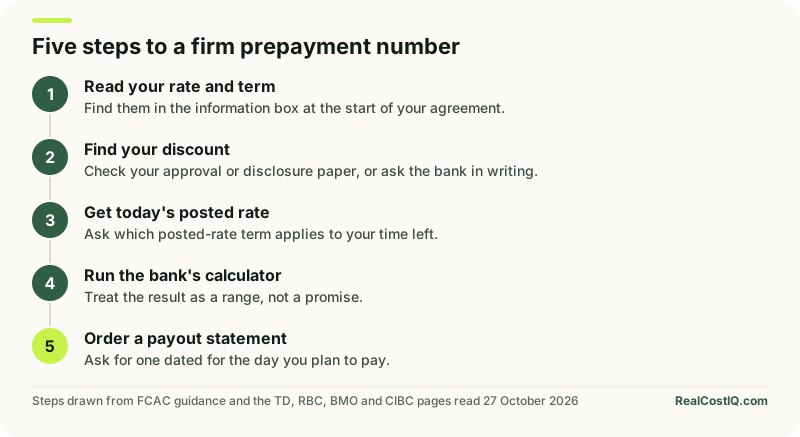
The Financial Consumer Agency of Canada (FCAC) adds a useful rule. It says key details must appear in an information box at the start of your mortgage agreement. It tells you to review the contract to see exactly how your lender will work out the penalty. It also says to ask your lender to explain anything you do not understand. Its page shows a date of 15 October 2025. It also says banks have a prepayment penalty calculator on their websites.
If you cannot find the discount, you can work it out. You need two facts: your rate, and the bank's posted rate for your term on the day you signed. The discount is the posted rate minus your rate. Use the date on your signed paperwork, not the date of the offer. Ask the bank, in writing, for the posted rate on that date and for the discount it has on file.
How a lender that is not a big bank can differ
A monoline lender does only mortgages. It has no branches and sells mostly through brokers. Its wording can differ from the banks'. First National, a monoline, defines the IRD on its prepayment page as the gap between your rate and “the current First National interest rate on a replacement mortgage.” That page was marked updated 26 October 2026 in its rates section. The definition itself has no date.
Look at what that wording leaves out. It talks about the rate on a replacement mortgage. It does not say “posted rate,” and it does not say “less your discount.” The page says changes to its posted rates affect the IRD, so posted rates do play a part somewhere. We cannot tell from the page how they enter. That is why you cannot assume a monoline is cheaper. You have to read its clause.
The FCAC says lenders usually apply the IRD when your rate is higher than today's and you signed less than five years ago. It also says methods vary. So the safest habit is the one it recommends. Read the contract first, ask questions second, and shop around at renewal.
Ways to shrink the number before you ask for a quote
- Use your prepayment privilege first. BMO's leaflet says to use your prepayment options before you pay off the mortgage in full. Lump-sum and payment-increase rights are free up to the yearly limit. BMO lists limits of 10% or 20% of the original amount, depending on the product. Scotiabank lists 10%, 15% or 20%. CIBC lists 10% to 20%. A smaller balance means a smaller IRD.
- Look at the calendar. BMO says that in the last three months of the term, the charge is just the interest to the end of the term. At the end of the term itself, Scotiabank says you can pay out or change terms with no charge.
- Check for a port. BMO and the FCAC both say you may be able to move your mortgage to a new home and keep the rate. A port can avoid the charge when it fits your plan. It has limits, so ask first.
- Check for cashback. BMO says if you got cashback and you pay off within five years, you repay a share. The share is months left in the term divided by 60, times the cashback. For C$5,000 of cashback and 15 months left, that is C$1,250.
- Ask about BMO's smart fixed product. BMO says that in the first five years of a smart fixed closed mortgage, you can only prepay in full if you are selling to an unrelated buyer or moving to another BMO mortgage.
A final point about long terms. BMO, RBC and Scotiabank each say that when a term is longer than five years and you pay out after year five, the charge drops to three months of interest. This links to a federal rule. We cover it in the section 10 post.
To test your own case, run the mortgage penalty calculator with the posted rates you collected. If you are close to the end of your term, compare the penalty with the cost of waiting using the mortgage renewal calculator.
What this post did not read
- We did not find any bank's current posted rates or any customer's discount. Every rate in the examples is invented to show the method.
- Scotiabank's leaflet is dated July 2018, and we did not find a newer one. Its online calculator page was found but not read. Confirm its current rules.
- TD's explainer is dated August 2020. Its calculator page and its break-your-mortgage page have no date.
- The CIBC and RBC consumer example pages have no date. RBC's form is dated May 2024, and BMO's leaflet June 2023.
- We did not read each bank's legal terms for your province. Standard charge terms can differ from the leaflets.
- MCAP and other monolines were not read in full, so no claim is made about them. The only monoline wording used is First National's.
- We have not tested any bank's calculator against its real bill. All five banks say their estimates are estimates.