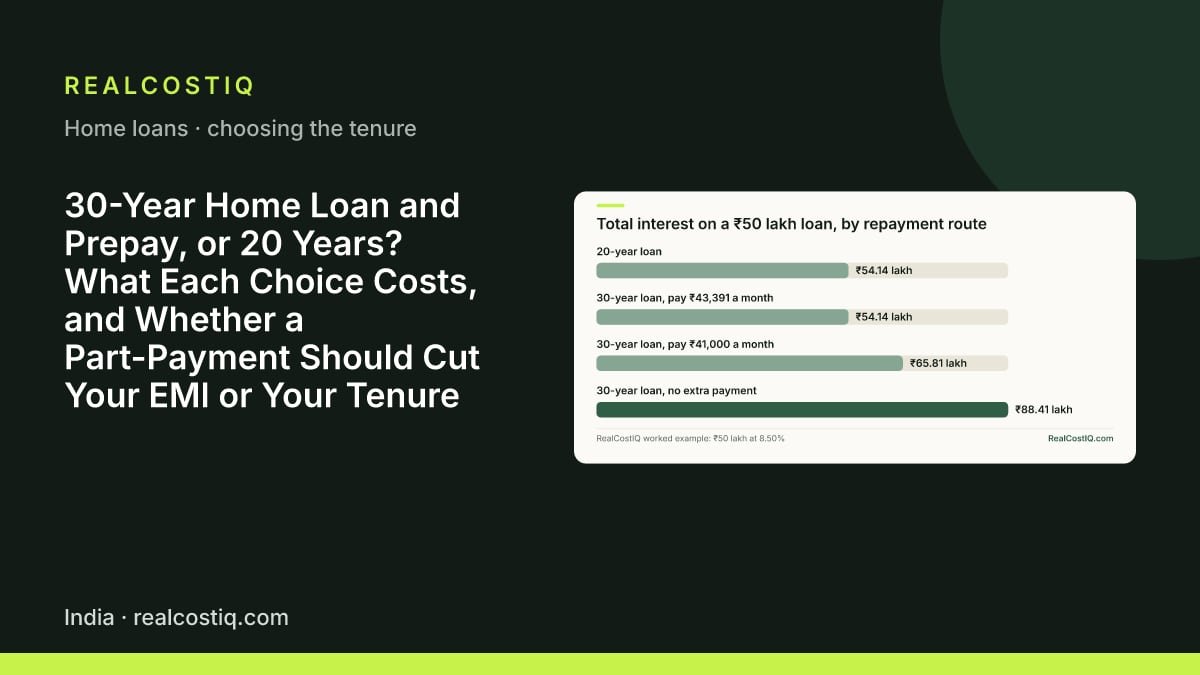
Most buyers choose a loan length by looking at the EMI. The EMI (equated monthly instalment) is the fixed amount you pay each month. A longer loan makes the EMI smaller, so it feels easier to say yes to. Then the first bonus, a tax refund or a year of salary growth arrives, and the question becomes whether to pay extra. This post answers two connected questions with one sample loan. First, is it better to take 30 years and prepay, or just take 20 years? Second, when you make a part-payment, should it cut your EMI or your tenure?
Tenure means the length of the loan. Prepayment means paying more than the EMI, either now and then or all at once. A part-payment is a one-time lump sum that goes straight against the principal, which is the amount you still owe. We use these words the same way all through the post.
How this was checked. We read the Reserve Bank of India rules on prepayment charges, and the Monetary Policy Committee resolution of 7 October 2026, on rbi.org.in on 1 November 2026. We read the home loan terms published by State Bank of India and HDFC Bank on the same day. The rules here are central ones that apply in every state. No state registry or stamp duty figure is used. For how the RBI reset rules work when your rate changes, and what a lender must disclose, see our post on rate resets. We do not repeat it here.
The sums are our own arithmetic on stated, made-up inputs. The rate of 8.50% is illustrative and is not a quote from any lender. To run your own loan, use the home loan EMI calculator, which has a prepayment input.
The example loan: ₹50 lakh at 8.50%
Take a loan of ₹50,00,000 at 8.50% a year on a floating rate, repaid by EMI with interest charged on the reducing balance. That means each month the bank charges interest only on what you still owe. Here is what the monthly EMI looks like for the two common lengths.
- 20 years (240 months): EMI of ₹43,391. Over the full term you pay ₹1,04,13,840, so the interest is ₹54,13,840, or about ₹54.14 lakh.
- 30 years (360 months): EMI of ₹38,446. Over the full term you pay ₹1,38,40,560, so the interest is ₹88,40,560, or about ₹88.41 lakh.
The 30-year EMI is ₹4,945 a month lower. In return, the longer loan costs about ₹34.27 lakh more in interest (₹34,26,720). That is more than two-thirds of the amount you borrowed. This is the price of the lower EMI if you never pay extra.
Why does ten more years add so much? In the early years of a long loan, almost all of your EMI is interest. In month one of the 30-year loan, the interest is about ₹35,417 and only about ₹3,029 of your ₹38,446 reduces the loan. The balance falls slowly, so the bank keeps charging interest on a big number for a long time.
Three ways to repay the same ₹50 lakh
Now add the third route. You take the 30-year loan, but you decide to pay a fixed amount each month that is higher than the EMI. The bank will still call your EMI ₹38,446. Anything above that is a prepayment. The table shows what happens at four payment levels.
| Route | You pay each month | Loan ends after | Total interest |
|---|---|---|---|
| 20-year loan | ₹43,391 | 240 months (20 years) | ₹54.14 lakh |
| 30-year loan, no extra payment | ₹38,446 | 360 months (30 years) | ₹88.41 lakh |
| 30-year loan, pay ₹40,000 | ₹40,000 | 307 months (25 years 7 months) | ₹72.77 lakh |
| 30-year loan, pay ₹41,000 | ₹41,000 | 283 months (23 years 7 months) | ₹65.81 lakh |
| 30-year loan, pay ₹43,391 | ₹43,391 | 241 months (20 years 1 month) | ₹54.14 lakh |
| 30-year loan, pay ₹45,000 | ₹45,000 | 220 months (18 years 4 months) | ₹48.60 lakh |
Monthly compounding on the reducing balance, 8.50% for the full loan, no fees. The 30-year loan paid at ₹43,391 ends one small instalment after the 20-year loan only because of rounding in the EMI. Interest for the prepaid routes is the sum of monthly interest until the balance reaches zero.
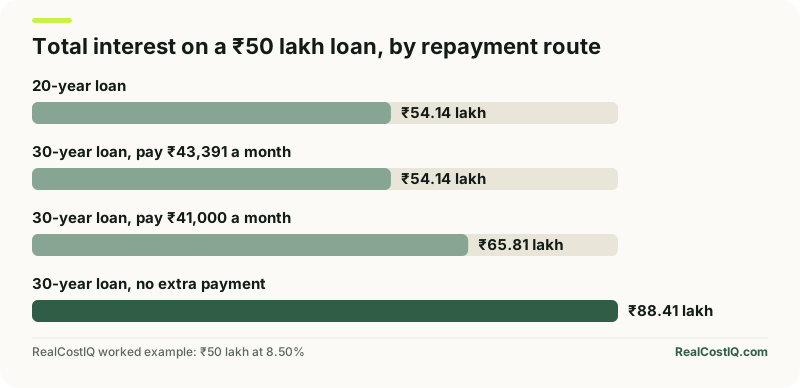
Read the fifth row first. If you take 30 years but pay ₹43,391 every month, the loan ends in 20 years and costs the same interest as the 20-year loan. The maths is the same. A loan does not know what it was called at the start. It only knows the rate and what you pay. So on cost alone, a 30-year loan with prepayment can do exactly what a 20-year loan does.
The sixth row shows the upside. If you pay ₹45,000, you finish about one year and eight months before the 20-year loan, and you pay about ₹5.54 lakh less in interest. You could not do that with a plain 20-year loan unless you also prepaid it.
What you are really buying with the 30-year loan
The 30-year route does not save money. At best it ties. What it gives you is a choice. In a bad month you can fall back to ₹38,446. The bank cannot call that a missed payment. On the 20-year loan, a bad month means a missed EMI of ₹43,391, which can hurt your credit record. So the extra ₹4,945 of room is a kind of insurance.
Insurance has a cost, and here it is a habit rather than a fee. The plan only works if you really do pay the higher amount. Many people mean to and do not. A good way to make it automatic is to set a standing instruction to pay the higher figure each month. Some banks let you set an auto-debit for the higher amount. Others need you to make a separate part-payment, either in the bank app or by cheque. Ask your bank which it is before you rely on it.
There is one more benefit of the longer loan. A bank decides how much it will lend partly by looking at your income and the size of the EMI. A smaller EMI can let you qualify for a bigger loan, or for a loan at all. Check this with the home loan eligibility calculator before you assume you can afford the 20-year EMI. If the 20-year EMI is a stretch for your salary, that is a reason to take 30 years, and not a reason to avoid it.
Can the bank charge you for prepaying?
This is the rule that makes the whole plan safe. Since 1 January 2026, on a floating-rate loan sanctioned or renewed from that date, a lender shall not levy pre-payment charges on an individual's loan taken for a purpose other than business, such as buying or building a home to live in. The RBI's Pre-payment Charges on Loans Directions, 2025, say so, with no lock-in period and whatever the source of the money. Our rate reset post sets out the rule in full, so we do not repeat it. Check your sanction date, and that your rate is floating, before you rely on it.
We also read what two large lenders say. State Bank of India's home loan terms say that no pre-payment or pre-closure penalty will be levied on floating interest home loans, whatever the period for which the account has run and whatever the source of funds. HDFC Bank's published charges page says there are no prepayment charges on floating-rate home loans unless the loan is taken for business purposes. HDFC lists a 2% charge for fixed-rate loans and combination-rate loans during the fixed period, except when you prepay from your own sources.
The risk of a long loan when rates rise
Floating-rate loans move with the market. On 7 October 2026 the Monetary Policy Committee raised the policy repo rate by 25 basis points to 5.50 per cent and changed its stance to calibrated tightening. (A basis point is one-hundredth of a percentage point.) In its statement the Reserve Bank said this signals that rate cuts are off the table in the near term, and that the next move can only be a hike or a pause. So a borrower today should plan for a rate that stays flat or goes up, and not one that falls.
A long loan is more exposed to this. Let us test it. The 20-year column in the table below is the example from our rate reset post: the same loan, the same rates, giving ₹47,92,181, ₹45,627 and 249 months. We add the 30-year column. Both loans below run for 24 months at 8.50%, and then the lender raises the rate to 9.25% for the rest of the term. Both are illustrative numbers. The 20-year borrower paid ₹43,391 a month. The 30-year borrower paid only the EMI of ₹38,446.
| 20-year loan | 30-year loan, EMI only | |
|---|---|---|
| Balance owed at month 24 | ₹47,92,181 | ₹49,21,054 |
| Months left | 216 | 336 |
| EMI to finish on time at 9.25% | ₹45,627 (up ₹2,236) | ₹41,043 (up ₹2,597) |
| If you keep the old EMI | Loan runs 249 more months, 33 extra | Loan runs 563 more months, 227 extra |
| Monthly interest at 9.25% on the balance | About ₹36,940 | About ₹37,933 |
After the reset the 30-year borrower's EMI of ₹38,446 is only about ₹513 more than that month's interest of about ₹37,933. Almost nothing reduces the loan. A lender will not let the term run to the figures shown in the keep-the-old-EMI row, because loans must end by a maximum age. The row shows the pressure, not a likely outcome.
This is the hidden risk of the minimum-EMI route. Two years into the loan, a 0.75 percentage point rise pushes the interest on a 30-year loan close to the whole EMI. If you do nothing, the loan will stretch for decades. The bank will normally force you to raise the EMI or the tenure, and the tenure has a ceiling. SBI's published terms, for example, allow a maximum of 30 years or up to age 70, whichever comes first. HDFC Bank's page also lists 30 years, or the age of retirement, whichever is lower.
Now compare a borrower who took 30 years but had been paying ₹43,391. At the reset, that borrower owes ₹47,92,181, the same as the 20-year borrower, and the loan runs 249 more months if the payment stays the same. If you only pay the ₹38,446 EMI, you can see that the long loan has less room, not more, once rates go up. So the safe version of the 30-year plan is the one where you really do prepay, and use the lower EMI only for emergencies.
A ₹5 lakh part-payment: cut the EMI or cut the tenure?
Say you get ₹5,00,000, perhaps from a bonus or a maturing deposit, and decide to put it against the 30-year loan. After the part-payment the bank will normally offer two ways to treat it. You can keep the EMI the same, which makes the loan end sooner. Or you can keep the end date the same, which lowers the EMI. The table shows both, for a ₹5 lakh part-payment made at three points in the loan, with the loan at 8.50% and an EMI of ₹38,446.
| When you pay | Balance before | Keep EMI: loan ends sooner by | Interest saved | Lower EMI instead: new EMI | Interest saved |
|---|---|---|---|---|---|
| After 2 years (month 24) | ₹49,21,054 | 97 months (about 8 years) | ₹32.40 lakh | ₹34,539 (down ₹3,907) | ₹8.12 lakh |
| After 10 years (month 120) | ₹44,30,066 | 57 months (about 4 years 9 months) | ₹17.13 lakh | ₹34,106 (down ₹4,340) | ₹5.41 lakh |
| After 15 years (month 180) | ₹39,04,029 | 40 months (about 3 years 4 months) | ₹10.46 lakh | ₹33,521 (down ₹4,925) | ₹3.86 lakh |
Keep-EMI months are the months left without the part-payment minus the months left with it. The lower-EMI case keeps the original end date. Interest saved is measured against the same loan with no part-payment. Real loans differ by day-count and by when the bank applies the payment.
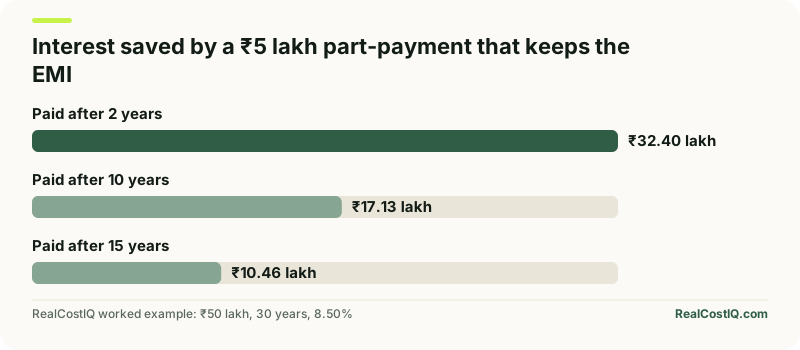
Two patterns stand out. First, keeping the EMI saves about four times as much interest as lowering it, if the part-payment is made after two years (₹32.40 lakh against ₹8.12 lakh). The reason is simple. When you keep the EMI, every later instalment pays down more of the principal than it otherwise would, so the interest falls faster each month. When you lower the EMI, you take the benefit as spare cash each month and the loan stays long.
Second, the earlier the better. The same ₹5 lakh saves ₹32.40 lakh in year two and ₹10.46 lakh in year fifteen. Interest is front-loaded. In the early years the bank is charging interest on a large balance, so each rupee you remove stops a long run of future interest.
When does lowering the EMI make sense? When your monthly budget is the problem and not the total cost. If a new baby, a job break or a second loan has made the EMI hard to pay, a lower EMI is a sound choice. You give up some savings to gain monthly room. But if you can manage the current EMI, cutting the tenure is almost always the better use of a lump sum. A middle path is to cut the tenure now, and then ask for the EMI to be reset later if cash gets tight.
How do you tell the bank which one you want? Banks differ. Some apply a part-payment to shorten the tenure unless you ask otherwise, and others need a written request or a form to lower the EMI. We did not find a central RBI rule that sets the default, so ask your lender in writing and keep the confirmation. After the payment, check the new repayment schedule against our table. The tenure or the EMI should have moved by about the amounts shown, if your balance and rate are close to the example.
Which loan length should you pick?
There is no single answer, but the table of costs gives a clear rule of thumb. If you can comfortably pay the 20-year EMI for the whole time, and you are not likely to need the cash for something else, take the shorter loan. It removes the temptation to skip the extra payment. If the 20-year EMI would take a large share of your income, or your income is likely to be uneven, take the longer loan and set up the higher payment as a habit.
- Choose 20 years if the EMI fits your budget with room to spare, your income is steady, and you know you may not keep up an extra payment on your own.
- Choose 30 years and pay the 20-year amount if the 20-year EMI is a stretch, your income may swing, or you want the lower EMI as a safety net. Do this only if you will really pay the higher amount.
- Choose 30 years and pay the minimum only if you need the lowest EMI for qualifying, and you plan to make large part-payments when money comes in. Watch the loan closely whenever the rate goes up.
Whichever you pick, compare more than the rate. Two lenders with the same rate can differ in processing fees, which for SBI's published salaried-customer terms are 0.35% of the loan amount, with a minimum of ₹5,000 and a maximum of ₹15,000, plus GST. A fee is charged on the amount, not on the tenure, so it does not change the 20-versus-30 choice, but it does change the lender choice. The home loan comparison calculator puts two offers side by side.
A simple plan to follow
- Work out the 20-year EMI for your loan amount. Use the home loan EMI calculator with your real rate.
- Check what share of your monthly take-home pay it takes. If it feels tight, plan for the 30-year loan.
- If you take 30 years, decide the extra amount now and set it up as a standing instruction. Write the amount down so you notice if you skip it.
- Read your sanction letter. Confirm the loan is floating-rate, confirm the sanction date, and confirm that the letter says no prepayment charge.
- When a lump sum arrives, make the part-payment as soon as you can. Ask for the tenure to be cut and the EMI kept, unless your budget needs the relief.
- When the rate changes, look at your balance and tenure. A rate rise is the best moment to raise your extra payment, as the cost of waiting grows faster on a long loan.
- Each year, run the prepayment calculator with your real balance to see how many months you have taken off.
What this post does not cover
This post is about the cost of the loan itself. It does not cover income tax on the interest you pay or on any home loan relief, because that is a personal tax question and belongs outside this site. It also does not cover switching to another lender for a lower rate, or the extra costs of buying a flat, such as stamp duty and registration, which vary by state. For those, see the other calculators on the site, starting with the home loan comparison calculator.
The worked loan, the rate and the part-payments are our own examples. They show how the numbers behave. They are not an offer, a forecast or financial advice. Your own balance, rate, fees and the date your bank applies a payment will move the results, so test your loan in the calculators before you act.