You paid a booking amount. Then the loan fell through, or the job moved, or the project stopped looking right. Now you want out. The first question is not how much you lose. It is who is breaking the deal. The Real Estate (Regulation and Development) Act, 2016 (RERA) treats the two cases very differently. If the builder is at fault, the law is on your side and the refund carries interest. If you are the one leaving, you are mostly bound by what you signed.
We do not repeat the RERA basics here. The RERA buyer rights guide explains the 10% advance limit and the right to withdraw. The RERA delay compensation calculator works out interest for a late flat you still want. This post is about the exit itself: what stays with the builder, what comes back, and how soon.
How this was checked. On 25 October 2026 we read the RERA Act, 2016 as published in the Gazette of India, the Ministry of Housing and Urban Affairs FAQ on the Act, the Uttar Pradesh RERA Rules of 2016, and the Uttar Pradesh Agreement for Sale Rules of 2018. We also read State Bank of India's published MCLR table. We could not load the model agreements of Maharashtra, Karnataka, Tamil Nadu or Telangana on the day. So every forfeiture term below is Uttar Pradesh's. Other states notify their own forms. Nothing here is legal advice.
Step one: which exit are you in?
Think of three doors. Door one: you leave and the builder has done nothing wrong. Door two: the builder fails to deliver, or its registration is cancelled, and you leave. Door three: you stop paying and the builder cancels you. The money that comes back is very different through each.
| Exit | Who is at fault | What the builder may keep | What you get back | Where it comes from |
|---|---|---|---|---|
| You withdraw, builder not at fault | Neither | The booking amount | 50% of the rest within 45 days, 50% on re-allotment or at 1 year | Clause 7.5, UP model agreement |
| Builder fails to deliver and you withdraw | Builder | Nothing | Everything paid, plus interest | Section 18(1) of the Act; clause 9.2 |
| Builder cancels because you stopped paying | You | Booking amount and interest due | The rest, after those deductions | Clause 9.3, UP model agreement |
Rules differ by state. The forfeiture and refund timings in the last column are from the Uttar Pradesh Agreement for Sale Rules, 2018, read on 25 October 2026. Your agreement for sale may differ.
What the RERA Act itself says about cancelling
The Act does not set a forfeiture figure. That surprises many buyers. It sets the frame, and the state fills in the numbers. Four sections matter here.
- Section 13(1) says a promoter cannot take more than 10% of the cost of the apartment as an advance or application fee unless a written agreement for sale is signed and registered first. On a ₹1 crore flat, that is ₹10 lakh.
- Section 13(2) says the agreement for sale must be in the form the state prescribes, and must state the rates of interest payable by the promoter and by the buyer if either defaults.
- Section 11(5) says the promoter may cancel an allotment only in terms of the agreement for sale. If the cancellation is not in line with the agreement, is one-sided, and has no good cause, you may go to the Authority for relief.
- Section 18(1) says that if the promoter does not finish or cannot hand over the flat by the date in the agreement, or loses its registration, you can withdraw. The promoter must then return the amount received, with interest at the prescribed rate and compensation.
Two more points from the Act matter for the money. Section 2(za) says the interest the builder pays you, and the interest the builder can charge you, must be the same rate. And the interest on a refund runs from the date the builder received each payment until the refund is made. That is a strong rule. It means a payment made two years ago has earned two years of interest, not just the last month.
The Ministry's own FAQ says the same about the 10% cap. The promoter cannot take more than 10% of the apartment cost as an advance or application fee. For any more, it must sign the agreement for sale. That agreement binds both sides, though the parties may add terms of their own.
Exit one: you walk away and the builder did nothing wrong
This is the common case. The sale was not cancelled by the builder's failure. You simply cannot or will not go ahead. The Act says you may withdraw, but only the state's agreement tells you what it costs.
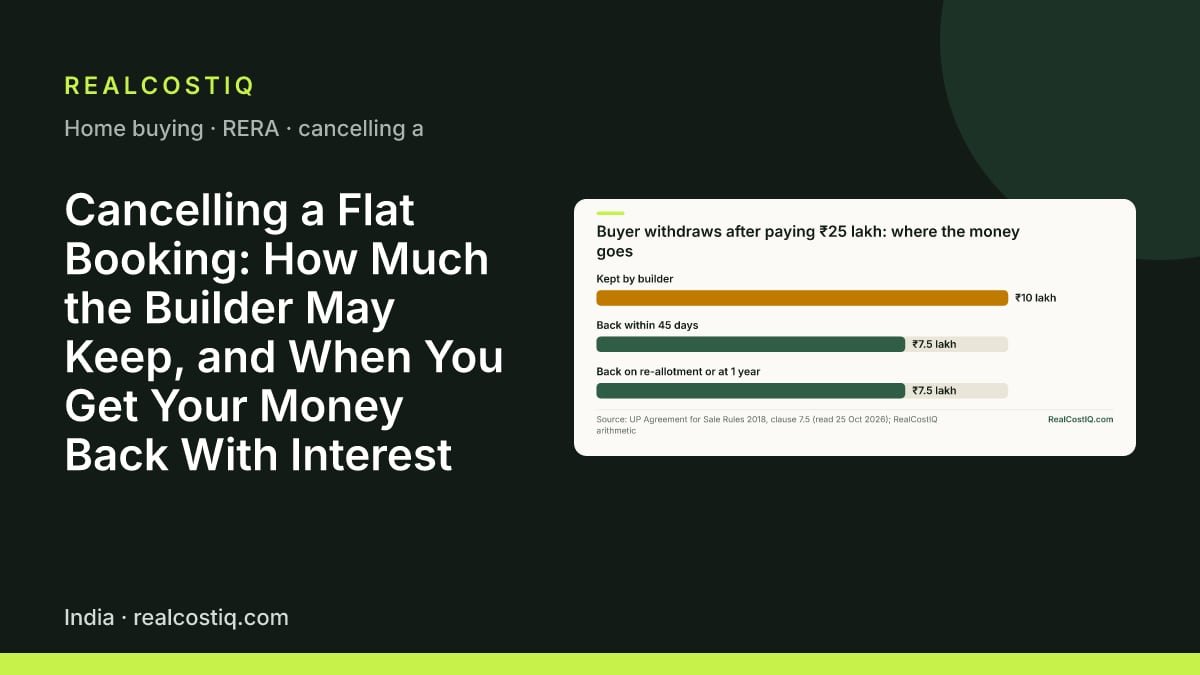
Clause 7.5 of the Uttar Pradesh model agreement is the rule we read. It says the buyer has the right to cancel or withdraw as provided in the Act. If the buyer cancels without any fault of the promoter, the promoter is entitled to forfeit the booking amount. The promoter must return 50% of the balance of the money paid within 45 days of the cancellation. It must return the other 50% when the flat is re-allotted, or at the end of one year from the cancellation, whichever is earlier. The promoter must also tell the earlier buyer the date of re-allotment and show it on the UP RERA website.
Worked example: a ₹1 crore flat, two cases
A ₹1 crore flat. The booking amount is ₹10 lakh, which is the 10% limit. Take three buyers. None of them has a builder at fault. Two have signed the agreement for sale. One has not.
- Buyer A has paid only the ₹10 lakh booking amount and has not signed or registered the agreement for sale. The UP model agreement says that if the buyer does not sign and register it after a notice, the application is treated as cancelled, and all sums deposited, including the booking amount, are returned without interest. Total back: ₹10 lakh, with no interest. Clause 7.5 applies only once the agreement is in force.
- Buyer A2 has paid the same ₹10 lakh, but has signed and registered the agreement, and then withdraws. The builder keeps ₹10 lakh. The balance paid is zero, so nothing is returned. Total back: ₹0.
- Buyer B has paid ₹25 lakh: the ₹10 lakh booking amount plus ₹15 lakh in later instalments. The builder keeps ₹10 lakh. The balance is ₹15 lakh. Half, ₹7,50,000 (₹7.5 lakh), is due within 45 days. The other ₹7,50,000 is due on re-allotment or after one year, whichever is first. Total back: ₹15,00,000 (₹15 lakh), in two parts. Total lost: ₹10 lakh.

Notice what the clause does not give you: interest on the money you wait for. The clause is silent on it. That second ₹7.5 lakh can sit with the builder for up to a year. At the home loan rates people pay, that wait has a real cost, even if the clause gives no interest. If you must exit, ask in writing how the date of re-allotment will be shown to you.
Exit two: the builder is at fault and you withdraw
Here the sums reverse. Section 18(1) lets you withdraw if the builder fails to finish or hand over by the date in the agreement, or loses its registration. The builder must return everything it received for that flat, with interest. The UP model agreement says the same in clause 9.2. If the builder defaults, the buyer may terminate. The builder then has to refund the entire money paid under any head, with interest at SBI's MCLR on home loans plus 1%, unless the Rules say otherwise. The deadline in the clause is 45 days from the termination notice. The UP RERA Rules, 2016 also say any refund with interest becomes payable within 45 days of falling due.
Two cautions about the rate. The clause says the rate is MCLR plus 1% unless the state Rules provide otherwise. We could not read the rate rule in the UP Rules in usable form, since the printed text of that rule did not come through. So we use the clause as written. Do not expect the same rate across states: each state fixes its own, and some use a different margin over MCLR. Check your state's Rules.
For the base rate, State Bank of India's published MCLR table, effective 15 October 2026, shows a one-year MCLR of 8.70% before the revision and 8.85% after it. The clause does not name a tenor, so the choice is ours. We use the one-year figure, 8.85%, as a plain benchmark. The table also lists a three-year rate of 8.95%, which would lift every interest figure below by one-tenth of a point. At plus 1%, the interest rate is 9.85%. These are illustrations of how the clause works, not a statement of what your state's rule says today.
Worked example: ₹25 lakh paid, builder fails to deliver
Use the same buyer who paid ₹25 lakh. To keep the sum simple, assume all of it was paid on one day and nothing was added. Interest is simple, from the day paid until the day refunded. Real payments come in stages, so your own interest would be built up payment by payment.
| Years the money was held | Interest at 9.85% (MCLR + 1%) | Total refund at 9.85% |
|---|---|---|
| 1 year | ₹2,46,250 | ₹27,46,250 |
| 2 years | ₹4,92,500 | ₹29,92,500 |
| 3 years | ₹7,38,750 | ₹32,38,750 |
Simple interest on ₹25,00,000 (₹25 lakh) at 9.85%. The base is the State Bank of India one-year MCLR of 8.85% effective 15 October 2026, plus 1%. The rate that applies to you is the one in your state's Rules and your agreement. Interest accrues from the date each payment was received.
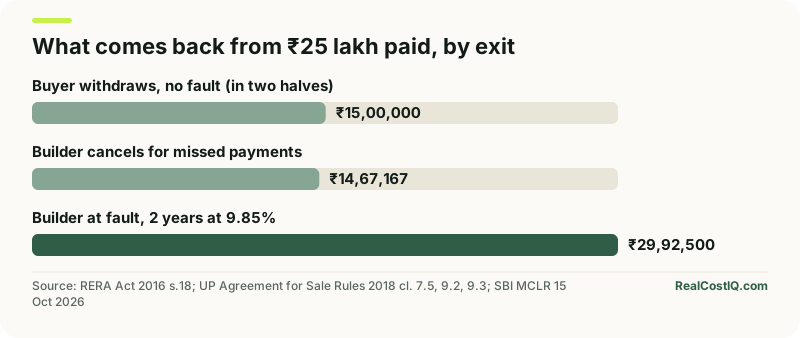
The gap is the point. On the same ₹25 lakh, the no-fault exit returns ₹15 lakh. The builder-fault exit returns nearly twice that, because the whole sum comes back and interest is added. That is why the facts of the delay matter. A buyer who has only a late-possession claim can often do better by staying and claiming delay interest. The RERA delay compensation calculator shows that route.
When the builder is at fault, what counts as fault?
Under clause 9.1 of the UP model agreement, the builder is in default if it fails to hand over ready-to-move-in possession by the date in the agreement or the registered completion date. Ready to move in means a habitable flat, complete in every way, with the occupation and completion certificate issued. The builder is also in default if its registration is suspended or revoked, and it stops doing business as a developer.
The model agreement also covers force majeure. The builder gets extra time for events outside its control. But if it becomes impossible to build the project, the allotment ends and the builder must refund the entire amount within 120 days. The model text does not add interest in that case. This is a real gap. A flat that dies of force majeure returns your principal and little more.
Section 12 of the Act adds a third route. If you paid an advance because of a false statement in an advertisement, prospectus or model flat, and you want out, the builder must return your entire investment with interest, plus compensation. This is the cleanest exit for a buyer who was misled. Keep the brochure and the advertisement.
Exit three: you stop paying and the builder cancels
Some buyers do not choose to leave. They fall behind. Clause 9.3 of the UP model agreement says a buyer is in default if they miss two consecutive demands in the payment plan after a notice. The buyer then owes interest on the unpaid amount at the same rate the builder would owe, which is MCLR plus 1% unless the Rules say otherwise. The builder must not itself be in default to use this right.
If the default continues for more than three months after the builder's notice, the builder may cancel the allotment. It then refunds the money paid, after deducting the booking amount and the interest liabilities. The builder must tell the buyer at least 30 days before the termination.
Note that this route has no 50-50 staging and no one-year wait in the text we read. The refund is the money paid, less the booking amount and the interest owed. That can be better than the voluntary exit if the dues are small. Work it through for our buyer. The buyer has paid ₹25 lakh, including the ₹10 lakh booking amount. One instalment of ₹10 lakh (10% of the price) went unpaid for four months. Interest at 9.85% on ₹10,00,000 for four months is ₹32,833. The refund is ₹25,00,000 less ₹10,00,000 less ₹32,833, which is ₹14,67,167.
Compare that with the voluntary exit on the same payments: ₹15 lakh, but in two parts, with the second part up to a year away. The cancel-for-default route returns almost as much, and all at once, but it ends your claim to the flat on the builder's terms. Section 11(5) protects you if the cancellation is one-sided, does not follow the agreement, and has no good cause. Then you may go to the Authority.
Before you cancel: a short checklist
- Find the cancellation clause in your signed agreement for sale. Check the word used for the part the builder may keep, and its size in rupees.
- Check what you have paid and under which heads: booking amount, instalments, taxes, and any other charge. Under clause 9.2 the refund on a builder default covers money paid under any head.
- Ask the builder in writing how the GST you paid will be treated. We did not read tax rules for this post, so we make no claim about it. The GST on property calculator shows what that tax is on a flat.
- Check whether the builder is itself in default: possession date, registration status on the state RERA site, and any false claim in its advertisement.
- Send any cancellation notice in writing and keep proof of delivery. The 45-day clock in the UP text runs from the notice or the date of cancellation.
- If the builder will not pay on time, file a complaint with the state Authority. That is the route the Act gives you.
What this post could not settle
We read one state's model agreement in full. The Act sets a frame and each state notifies its own form of agreement and its own interest rate. A flat in Maharashtra, Karnataka, Tamil Nadu or Telangana may carry different forfeiture and refund terms. We could not load those states' texts on the day, so we do not state their terms. If your flat is in another state, treat the worked numbers as the shape of the problem, not as your answer.
Second, a registered agreement for sale may add terms. The Ministry FAQ says the agreement binds both sides, and that parties may add terms. A clause that adds a big cancellation charge may be open to challenge before the Authority. We have not read any case on that, so we say nothing about the outcome.
Third, the interest sums are simple interest on one lump sum. Your real payments come in instalments, so your interest will be built payment by payment. For a project already late, use the delay calculator to see the interest you would earn by staying in.
Cancel, wait or negotiate: how to decide
If the builder has missed the date, do the sums both ways. Compare a full refund with interest against staying in the project and collecting delay interest. For many buyers who still want the flat, staying and collecting interest is the better route, since it keeps both the flat and the claim. For buyers who have lost trust in the builder, the refund is the cleaner exit, and the interest is a real sum.
If the builder is on time and you are the one leaving, the cost is the booking amount, and the wait on the rest. Before you sign anything new, look for a swap. Some builders will move your payments to another unit. Others will find a buyer for your allotment. Both can save the forfeit, but neither is a right under the text we read. They are a matter of negotiation.
The simplest rule is this. Know which door you are walking through before you send the letter. The same ₹25 lakh returned ₹15 lakh through one door and nearly ₹30 lakh through another. The words in your notice, and the facts behind them, are what decide it.