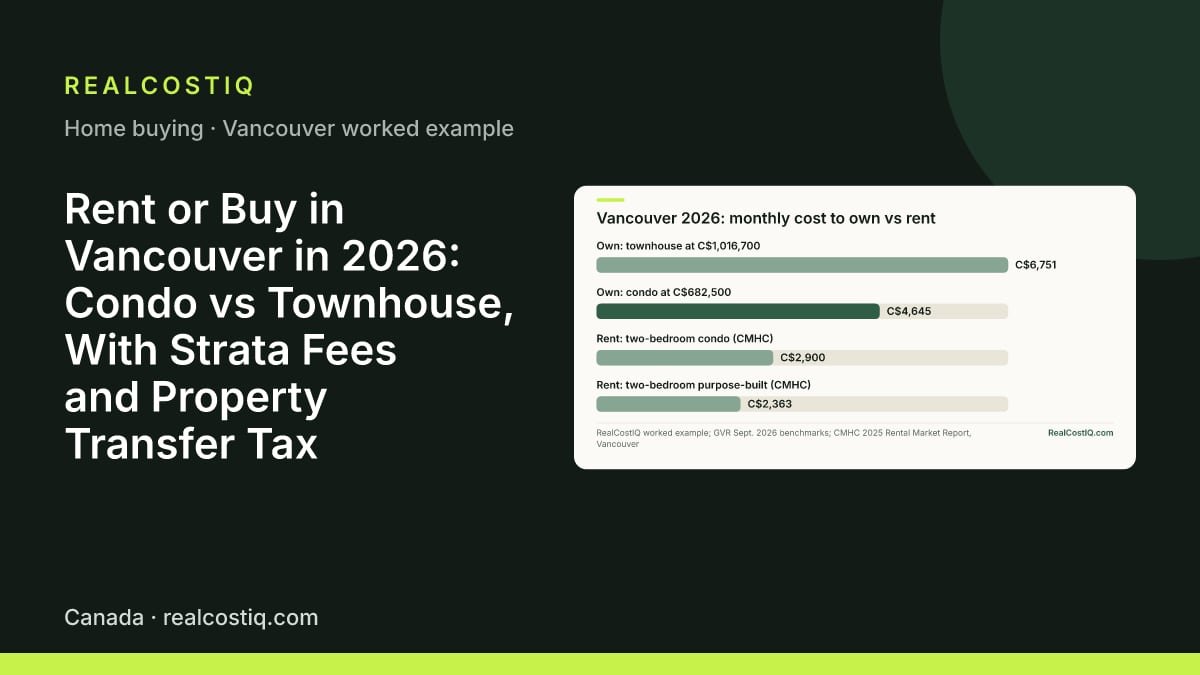
Renting costs less each month in Vancouver. That part is easy to see. The harder question is what happens over ten or fifteen years. A buyer builds equity, which is the part of the home you own. A renter keeps the cash a buyer would have spent on a down payment and closing costs, and can invest it. This post works through both sides with Vancouver numbers. All money is in Canadian dollars (CAD).
What we compare, and what we do not
Break-even means the first year when the buyer's total wealth passes the renter's. A buyer's wealth is the home's value, minus the mortgage still owed, minus the cost of selling. A renter's wealth is the invested savings. Each side keeps a running total.
Opportunity cost is the money you give up by choosing one path. The cash you put into a down payment can no longer be invested. That lost growth counts against buying. The rent you pay counts against renting, because it builds no equity. A fair comparison counts both.
We use the engine behind our rent vs buy calculator, with named inputs. It uses Canadian mortgage math. A Canadian fixed rate is compounded twice a year, which gives a slightly lower payment than dividing the rate by 12. It adds the BC property transfer tax and the CMHC insurance premium. CMHC is the Canada Mortgage and Housing Corporation, a federal Crown corporation. Its insurance is required when the down payment is under 20%.
We have already done this for Toronto. Our Toronto rent vs buy post uses the same method. This post is about Vancouver only. The differences are real. BC charges one transfer tax, not two. Strata fees (BC's word for condo fees) and the rules for strata reserves are different. Rent data come from CMHC's Vancouver report. We do not cover other cities, and we do not tell you what to do. Your job, family plans and comfort with risk matter more than any average.
The prices and the rents we used
Greater Vancouver Realtors (GVR) publishes a benchmark price each month. A benchmark is the price of a typical home of its type, which smooths out the mix of homes sold. GVR's September 2026 figures, which we read through a site that republishes GVR's table, show an apartment benchmark of C$682,500, down 6.2% from September 2025. The attached (townhouse) benchmark was C$1,016,700, down 4.7%. The composite benchmark for all home types was C$1,075,900, down 5.5%. The Canadian Press, which also quotes GVR, reported the same composite and said September sales were down 8.4% from a year earlier. GVR's own page blocked our access on the day we checked, so the apartment and townhouse figures come from the republished table. Check GVR's monthly package for the latest month.
For rent we use CMHC's Rental Market Report for the Vancouver area, which covers October 2025. The average two-bedroom condominium apartment rented for C$2,900. The average two-bedroom in a purpose-built rental building rented for C$2,363. Purpose-built means a building made to be rented, not a condo unit that an owner rents out. The vacancy rate was 1.5% for condos and 3.7% for purpose-built units. CMHC also reports an average turnover rent of C$2,696 for a purpose-built two-bedroom, which is the rent a new tenant pays when a unit changes hands. BC's allowed rent increase for sitting tenants was 3% in 2025, according to CMHC.
CMHC's page gives no Vancouver rent for a townhouse, so we do not make one up. For the townhouse we test several rents and also solve for the rent at which buying breaks even. That turns a weak input into a clear question: what rent would make this purchase pay?
| Input | Condo | Townhouse |
|---|---|---|
| Price (GVR September 2026 benchmark) | C$682,500 | C$1,016,700 |
| Minimum down payment | C$43,250 | C$76,670 |
| CMHC premium (4.00%, added to the loan) | C$25,570 | C$37,601 |
| Mortgage after premium | C$664,820 | C$977,631 |
| BC property transfer tax, no exemption | C$11,650 | C$18,334 |
| Strata fee (placeholder) | C$490 a month | C$420 a month |
| Rent compared | C$2,900 (CMHC two-bedroom condo) | C$2,900 to C$4,000, tested |
Hypothetical. Down payment follows the FCAC rule: 5% of the first C$500,000 and 10% of the rest, with 20% required at C$1.5 million or more. CMHC's table sets 4.00% for a loan between 90.01% and 95% of the price. Transfer tax from the BC government's rate page. Mortgage on the townhouse is C$940,030 plus the premium.
The cost of owning each month
The down payment follows the Financial Consumer Agency of Canada (FCAC) rule. For a price between C$500,000 and C$1.5 million, you need 5% of the first C$500,000 plus 10% of the rest. On the condo that is C$25,000 plus C$18,250, or C$43,250. On the townhouse it is C$25,000 plus C$51,670, or C$76,670.
Both loans are more than 90% of the price, so CMHC charges 4.00%. On the condo that is 4.00% of C$639,250, or C$25,570. We add it to the loan, so the mortgage is C$664,820. We use an example rate of 4.50% and a 25-year amortization. Amortization is the full time to repay the loan. It is not the same as the term, the length of one contract, which is often five years. The rate is an illustration, not a quote. For context, the Bank of Canada's policy rate was 2.50% after its October 28, 2026 move, and its page of posted bank rates showed 6.19% for a five-year conventional mortgage. Posted rates are the banks' list prices, and most buyers negotiate well below them.
Property tax comes next. We use the City of Vancouver's 2026 residential rate of C$3.36394 per C$1,000, which is 0.336394%. On C$682,500 that is about C$2,296 a year, or C$191 a month. This is a stand-in. The tax is based on the assessed value, which can differ from your price, and we leave out the BC home owner grant. We add C$284 a month for upkeep on the condo, which is 0.5% of the price a year, and 0.75% on the townhouse for its exterior.
A strata fee is the monthly bill to the strata corporation. It pays for building insurance, shared repairs and savings for big jobs. We priced it from Zealty's June 2026 guide, updated August 12, 2026. It puts Metro Vancouver condos at C$0.55 to C$0.90 per square foot a month and strata townhouses at C$0.20 to C$0.45. Zealty does not say where those ranges come from. So we treat them as placeholders. We use a 700-square-foot condo at C$0.70, which is C$490, and a 1,200-square-foot townhouse at C$0.35, which is C$420. Your fee is on the strata documents. Fees vary a lot by building.
| Item | Condo, C$682,500 | Townhouse, C$1,016,700 |
|---|---|---|
| Mortgage principal and interest | C$3,679.60 | C$5,410.92 |
| Property tax (0.336394% of price) | C$191.32 | C$285.01 |
| Strata fee (placeholder) | C$490.00 | C$420.00 |
| Upkeep (0.5% and 0.75% of price a year) | C$284.38 | C$635.44 |
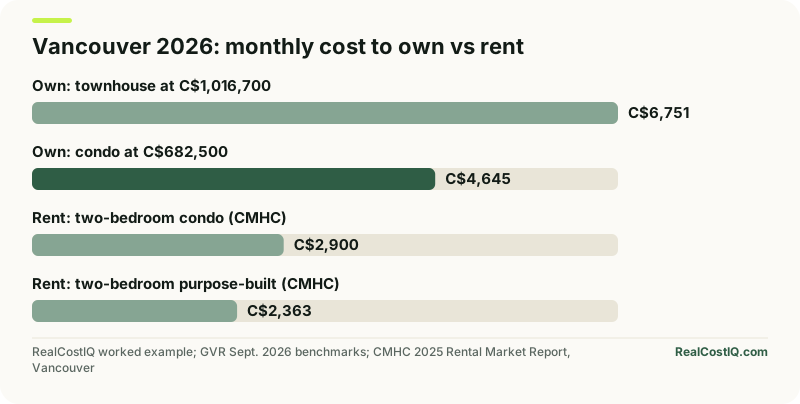
| Total to own | C$4,645.30 | C$6,751.37 |
| Rent: two-bedroom condo, CMHC 2025 | C$2,900.00 | C$2,900.00 |
| Owning costs more by | C$1,745.30 | C$3,851.37 |
Hypothetical. Mortgage payment from the site's engine with semi-annual compounding. Property tax rate: City of Vancouver 2026 residential total, as recorded in our property tax data on 2026-09-16 (the City's page returned an access error on 2026-11-01). Home insurance and utilities are not included on either side.
Look at the condo's gap first. Owning costs C$1,745.30 a month more than renting a two-bedroom condo. Most of that is the mortgage. Interest is the biggest piece of the payment in the early years. Now compare with a purpose-built rental. The same two-bedroom costs C$2,363 in a rental building, and the gap grows to C$2,282.30 a month. Purpose-built rents are lower. CMHC's condo vacancy rate of 1.5% shows that condo rentals are scarce.
The cash you need on day one
Buying also takes cash at closing, and the renter keeps that cash. The big item is the property transfer tax (PTT), a one-time tax on the price, paid when the home changes hands. The BC government's page sets it at 1% on the first C$200,000, 2% on the amount from C$200,000 to C$2,000,000, 3% above C$2,000,000, and a further 2% on the residential part above C$3,000,000. On the condo, 1% of C$200,000 is C$2,000, and 2% of the remaining C$482,500 is C$9,650. The total is C$11,650. On the townhouse it is C$2,000 plus 2% of C$816,700, which is C$18,334.
Vancouver has no second city transfer tax, unlike Toronto. The engine adds no sales tax on the CMHC premium in BC, because CMHC lists only Quebec, Ontario and Saskatchewan as charging it. We add C$4,000 for legal fees, inspection and other closing items. That is the engine's round allowance, not a quote.
| Item | Condo (CAD) | Townhouse (CAD) |
|---|---|---|
| Down payment | C$43,250 | C$76,670 |
| BC property transfer tax | C$11,650 | C$18,334 |
| Legal, inspection and other closing costs (allowance) | C$4,000 | C$4,000 |
| Total cash at closing | C$58,900 | C$99,004 |
Hypothetical. This total is also the starting investment we give the renter in each case. The CMHC premium is financed, so it is not cash. Details of BC closing costs are in the BC closing costs calculator.
A first-time buyer pays less. The BC government says a first-time buyer is exempt from tax on the first C$500,000 of the price when the property is worth C$835,000 or less, with a partial exemption up to C$860,000. You must be a citizen or permanent resident, never have owned a principal residence anywhere in the world, and live in BC for a year or have filed two BC tax returns in the last six. You must move in within 92 days and stay a year. The condo qualifies. The townhouse at C$1,016,700 does not. With the exemption the condo's transfer tax falls from C$11,650 to C$3,650. We do not repeat the move-in rules or the clawback here. They are in our BC first-time buyer exemption post. To see your own case, use the BC closing costs calculator.
What happens over the years: the condo
Now we run both paths forward. We make three guesses and say so. Rent rises 3% a year. The condo gains 2% a year in value. Savings that the renter invests earn 5% a year. None is a forecast. GVR's September 2026 apartment benchmark was down 6.2% from a year earlier, so 2% growth already assumes a recovery.
The renter starts with C$58,900, the cash the buyer pays at closing. The renter then invests the monthly gap, which starts at C$1,745 and shrinks as rent rises. The buyer's wealth is the home's value, minus the mortgage balance, minus the cost to sell. The tool takes selling costs off the buyer's wealth in every year, as if the home were sold that year. By default that is a 5% commission, GST on it, and C$2,900 for legal and discharge fees. It leaves out any mortgage penalty for breaking your term early.
| Year | Buyer, after selling costs | Renter, rent C$2,900 | Renter, rent C$2,363 |
|---|---|---|---|
| 1 | C$6,697 | C$83,344 | C$89,937 |
| 5 | C$127,387 | C$182,704 | C$221,367 |
| 10 | C$303,048 | C$308,333 | C$402,772 |
| 15 | C$511,701 | C$431,008 | C$604,167 |
| Break-even year | - | 11 | None within 15 years |
Hypothetical, from the site's rent vs buy engine: 4.50% rate, 25-year amortization, minimum down, BC transfer tax with no exemption, C$490 strata fee. In year 10 the selling costs on the condo are C$46,578. Neither side pays tax on investment gains here.
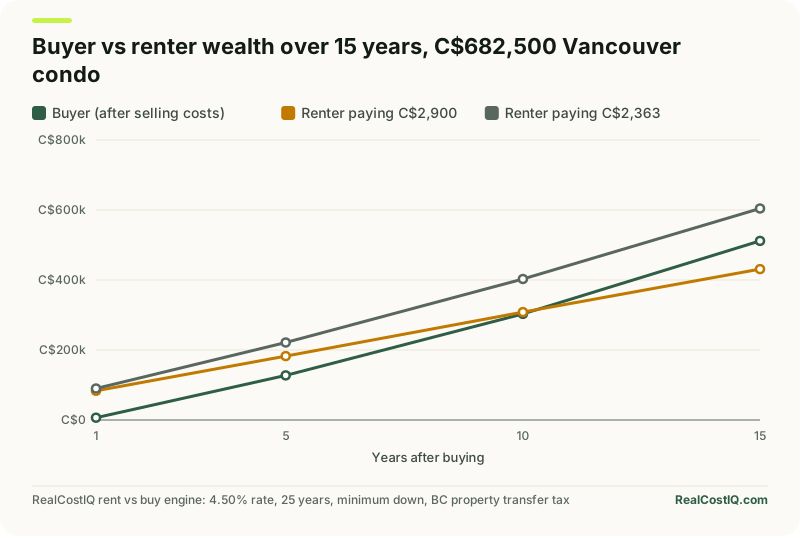
Read the table slowly. After one year the buyer is far behind, because closing costs and selling costs are gone. After five years the buyer has closed some of the gap. Only in year 11 does the buyer pass the C$2,900 renter, and the lead is thin. At year 10 the two are within about C$5,300 of each other (C$303,048 against C$308,333). Against the C$2,363 rent, which saves the renter more each month, the buyer never catches up in 15 years.
The first-time buyer exemption helps. With the transfer tax cut to C$3,650, the closing cash falls to C$50,900. The break-even year moves from 11 to 10 against the C$2,900 rent. Against C$2,363 it still does not break even.
How much the answer moves
A break-even year looks exact. It is not. It moves a lot with the three guesses and with the strata fee. We changed one input at a time on the condo, with the C$2,900 rent.
| What we changed | Break-even year |
|---|---|
| Base case (4.50%, 2% growth, C$490 strata fee) | 11 |
| Mortgage rate 3.50% | 7 |
| Mortgage rate 5.50% | None within 15 years |
| Home price growth 0% a year | None within 15 years |
| Home price growth 4% a year | 5 |
| Strata fee C$700 instead of C$490 | 14 |
| First-time buyer exemption (transfer tax C$3,650) | 10 |
Hypothetical, from the same engine. Only the named input changes. Rent C$2,900 growing 3% a year, 5% return on saved cash, 15-year horizon.
Two things stand out. First, price growth swings the answer most. If the condo gains nothing for 15 years, buying never breaks even. If it gains 4% a year, buying pulls ahead in year 5. Nobody knows which is closer to the truth. Second, a C$210 higher strata fee moves the answer from year 11 to year 14. That is why you must read the strata documents before you buy. The fee is not a side detail. It can be the difference between breaking even and not.
The townhouse: why it needs a different question
A C$1,016,700 townhouse costs C$6,751.37 a month to own in our setup. Against the C$2,900 condo rent, owning costs C$3,851.37 more, and buying does not break even within 15 years. At year 15 the buyer has C$770,498 and the renter has C$1,078,706. But that compares a larger home with a two-bedroom condo rental, which is not a fair match.
So we ask a different question. What rent would make the purchase pay? We solved for it. Buying breaks even within 15 years if the rent you avoid starts near C$3,856 a month. To break even within 10 years it must start near C$4,261. CMHC gives no townhouse rent for Vancouver, so check listings for homes like the one you would buy. If comparable rentals cost less than about C$3,900, the numbers favour renting on money alone.
| Starting rent (CAD a month) | Owning costs more by | Break-even year | Buyer wealth, year 15 | Renter wealth, year 15 |
|---|---|---|---|---|
| C$2,900 | C$3,851 | None within 15 years | C$770,498 | C$1,078,706 |
| C$3,500 | C$3,251 | None within 15 years | C$770,498 | C$885,232 |
| C$4,000 | C$2,751 | 13 | C$770,498 | C$724,003 |
Hypothetical, from the same engine and inputs as the condo, with a C$420 strata fee and 0.75% upkeep. No first-time exemption, because the price is above C$860,000. The buyer's figure is the same in every row because only the rent changes. Rents of C$3,500 and C$4,000 are test values, not data.
A townhouse also brings things a condo does not. You may control more of your own space. Strata townhouses have lower fees per square foot in Zealty's range, but some stratas do not cover roofs and siding, so you pay for those on your own. Ask the strata what it covers before you compare fees.
Strata reserves: what to read before you buy
The strata fee is a monthly bill. The reserve is what stops a surprise bill. In BC the reserve is called the contingency reserve fund (CRF). The BC government says it pays for costs that come less than once a year, such as a roof, an elevator upgrade or repaving. Since November 1, 2023, a strata must put at least 10% of its yearly operating budget into the CRF. Most already put in more.
The province also requires a depreciation report, which is a professional forecast of the repairs a strata will face and how to pay for them. Stratas with five or more lots must get one every five years. The report must include at least three cash-flow funding models over 30 years. The province lists a staged deadline for existing stratas. For Metro Vancouver the date was July 1, 2026. Ask for the latest report on any unit you plan to buy. If the strata has none, or the report is old, that is a flag.
Spending the CRF usually needs a 3/4 vote of owners. When it runs short, a strata can raise a special levy. A levy is a one-time bill split among owners. We cover the documents you get as a buyer in our post on the status certificate and its equivalents, which includes BC's Form B. For the cost side, compare the strata fee with your budget the way we did above. A low fee that gives the CRF only the 10% minimum is not the same as a strong reserve.
Can you qualify? A note on the stress test
Lenders test your payment at a higher rate than the one you will pay. For CMHC-insured loans, CMHC says the qualifying rate is the greater of your contract rate plus 2 percentage points or 5.25%. At our 4.50% example, the test rate is 6.50%. CMHC also says 50% of the strata fee counts in your debt ratios and caps housing costs at 39% of gross income. That page dates from 2018, so ask your lender for today's rules. The fee counts only in part, but you pay all of it, so use the full amount in your own budget. Our mortgage stress test post explains the test in plain steps.
What would change the answer for you
- How long you will stay. Under five years, the closing costs and selling costs rarely pay back.
- Your real rent. If you can rent a purpose-built unit near C$2,363, buying has a long way to go. If your alternative is a C$3,500 condo, it is closer.
- Your real rate. The gap between 3.50% and 5.50% was the gap between year 7 and no break-even.
- The building. A strata with a big fee, an old roof and a thin reserve can erase the benefit.
- Whether you qualify for the first-time exemption. It takes C$8,000 off the tax on a condo near C$682,500.
- Whether you would invest the difference. The renter's side only works if the gap actually gets saved.
A short checklist before you decide. Get the strata fee and the depreciation report. Check that you can pay for the first year in cash, which is about C$58,900 for the condo, with a cushion left over. Compare to a rent you could really sign for. Run your own numbers in the rent vs buy calculator. These are general facts, not financial advice. Rates, thresholds and rents change, and the figures above were read on November 1, 2026.
We looked for a recent forum thread on this question on RedFlagDeals and Reddit and could not reach either site's discussions, so we cite none.