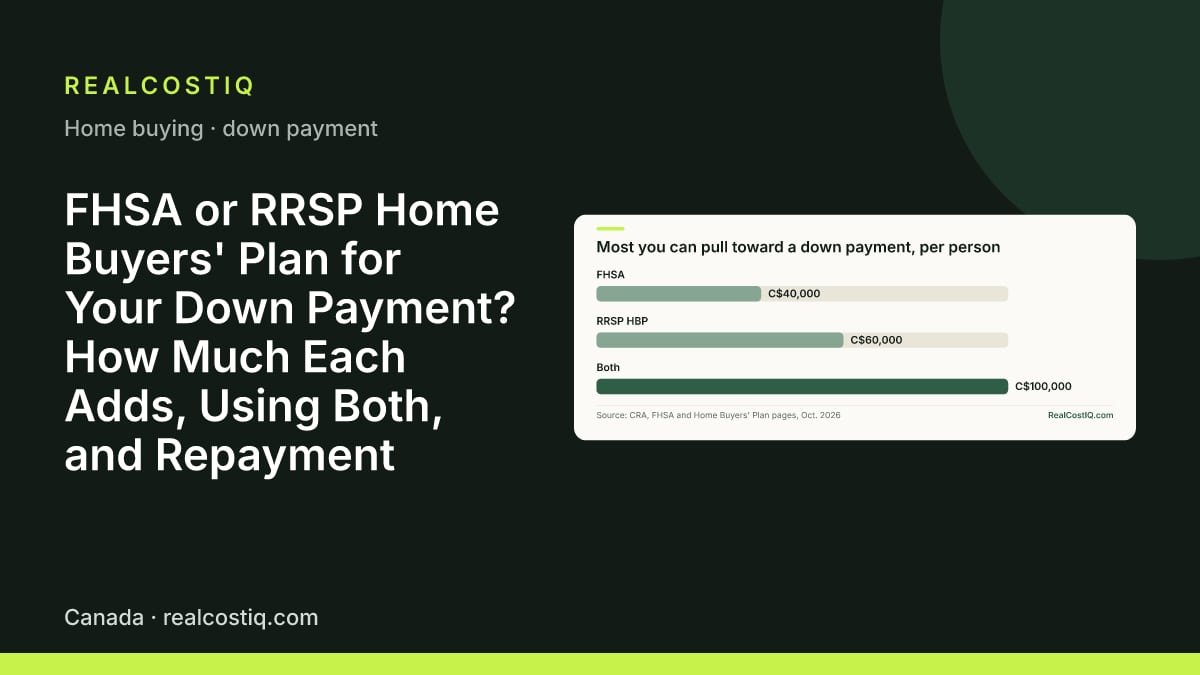
Two federal programs help first-time buyers in Canada save a down payment. One is the First Home Savings Account (FHSA). The other is the RRSP Home Buyers' Plan (HBP). They sound alike. They work very differently. One is a new account built for this goal. The other lets you borrow from your own retirement savings and pay yourself back.
This post puts them side by side in Canadian dollars (CAD). We read the Canada Revenue Agency (CRA) pages on both, the Department of Finance budget update, and CMHC's down payment and premium rules. Then we run one example: a C$600,000 home. We do not give tax advice or plan tax refunds. We cover the rules and what each program adds to your down payment.
In plain English
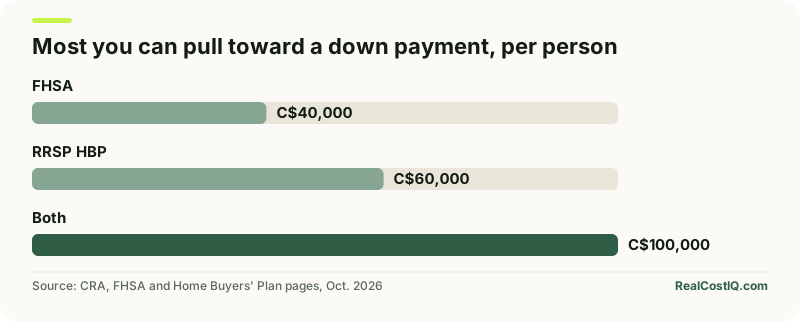
- FHSA: a new account for first-time buyers. You can put in C$8,000 a year, up to C$40,000 in your lifetime. A qualifying withdrawal for a home is not taxed and does not need to be repaid.
- HBP: you take money out of your own RRSP, up to C$60,000, to buy a home. It is not taxed when you take it out. You must put it back over 15 years, or the missed amount is added to your income.
- Both together: CRA says you can make a qualifying FHSA withdrawal for the same home as an HBP withdrawal, if you meet every condition for each.
- The big question is not which is better. It is which one has your money. You can only use the HBP if you already hold RRSP savings. The FHSA only helps if you have time to fill it.
- Both are for first-time buyers. The test looks at whether you lived in a home you or your spouse owned in the current year or the four years before.
The FHSA: what the CRA says
How much goes in
CRA says your FHSA participation room in the first year you open an FHSA is C$8,000. Each year after, you get C$8,000 more, plus any unused room you carry forward. CRA's definitions page sets the lifetime limit at C$40,000. Its contributing page says the carry-forward is capped, so you can have at most C$16,000 of room in a year (C$8,000 new, plus C$8,000 carried over). The carry-forward is C$0 in the year you open the account. So you cannot catch up all at once. It takes five years to reach C$40,000.
| After year | Most you can have put in | Note |
|---|---|---|
| 1 | C$8,000 | First-year room is C$8,000 |
| 2 | C$16,000 | Skip year 1 and you can still put C$16,000 in year 2 |
| 3 | C$24,000 | C$8,000 a year |
| 4 | C$32,000 | C$8,000 a year |
| 5 | C$40,000 | Lifetime limit reached |
Our arithmetic from CRA's FHSA pages (contributing page modified 2026-09-17; definitions page modified 2026-02-05). Investment growth is extra and is not counted against the limit. Transfers from an RRSP also use up room.
Time is the catch. If you plan to buy in two years, you can contribute at most C$16,000. If you plan to buy next spring, you can put in C$8,000 now. The sooner you open the account, the more room you build, even if you do not fill it yet. Our FHSA calculator shows what a plan of contributions grows to.
Getting the money out
CRA's definitions page lists what makes a withdrawal "qualifying", which means no tax on it. You must give your FHSA issuer Form RC725. You must be a first-time home buyer. You need a written agreement to buy or build a qualifying home, with the closing or build date before October 1 of the year after the withdrawal. You must not have acquired the home more than 30 days before the withdrawal. You must stay a Canadian resident. And you must plan to live in the home as your main home within one year.
A qualifying home is in Canada. CRA lists houses, semi-detached homes, townhouses, mobile homes, condo units, and apartments in duplexes up to apartment buildings. A co-operative share counts if it gives you equity in a unit, but not if it only gives a right to rent.
The account has an end date
Your maximum participation period starts when you open your first FHSA. It ends on December 31 of the earliest of three events. The 15th anniversary of opening the account. The year you turn 71. Or the year after your first qualifying withdrawal. That last one matters. After you buy, the account winds down on a short clock. Plan for it.
The deduction
CRA says contributions are generally tax deductible, and only the account holder can claim the deduction. You may deduct in the year you contribute or in a later year. The most you can deduct over your lifetime is C$40,000. Contributions made in the first 60 days of a year cannot be deducted on the previous year's return. Transfers from your RRSP to your FHSA are not deductible. We stop there. How big the deduction is for you depends on your income, and that is a tax question we do not cover.
The Home Buyers' Plan: what the CRA says
How much you can take
CRA's HBP page says the withdrawal limit is currently C$60,000, and that you make repayments over a 15-year period. The participation page adds that this is the total per participation period, and only from your own RRSPs. Locked-in and group RRSPs generally do not qualify. Two buyers can each use the plan, so a couple could take up to C$120,000 if both hold the savings. Our RRSP HBP calculator builds the repayment schedule.
The rules to meet
- Residency. You must be a Canadian resident at withdrawal, and stay one until you acquire the home.
- A written agreement. You need a written agreement to buy or build a qualifying home. A mortgage pre-approval does not count, CRA says.
- The deadline. The home must be acquired or built by October 1 of the year after your first withdrawal. Limited extensions exist.
- Move in. You must intend to live in it as your principal home within one year.
- First-time buyer. You must not have lived in a home you or your spouse or common-law partner owned in the current year (before the 30 days before the withdrawal) or the four years before. There are exceptions for some cases.
- Past use. If you used the HBP before, your balance must be zero on January 1 of the withdrawal year.
- Forms and timing. Form T1036 for each withdrawal. Multiple withdrawals are allowed only in the first calendar year and in January of the next.
- New contributions. CRA says contributions made in the 89 days before a withdrawal may not be deductible. If you plan to top up your RRSP just to withdraw it, read this rule first.
When repayment starts
The usual rule is that repayment begins in the second year after the withdrawal. CRA's repayment page says the start moves to the fifth year after the withdrawal year for withdrawals made from 2022 through 2025. Its HBP page says the same relief applies to first withdrawals from January 1, 2026 to December 31, 2028, and gives an example: a first withdrawal in 2026 means your first repayment year is 2031. That is a five-year gap before the 15-year clock starts.
What repayment looks like
CRA says your minimum each year is your withdrawal divided by 15, at first. A C$60,000 withdrawal means at least C$4,000 a year, or about C$333 a month. You repay by putting money into an RRSP and marking it as an HBP repayment on Schedule 7. You can do it during the year or in the first 60 days of the next. You can repay faster, and extra amounts lower your future minimums. If you pay less than the minimum, the shortfall is added to your income. If you pay nothing, the whole minimum is added to your income, and your HBP balance drops by that amount. The money you repay is not a cost. It goes back into your own RRSP. The cost is the years it did not grow there.
Two repayment traps. You cannot count a transfer from your FHSA as an HBP repayment. And contributions to a spouse's RRSP do not count either. CRA lists both. Also, if a missed repayment gets added to income, the tax is due for that year.
FHSA vs HBP, side by side
| Question | FHSA | RRSP Home Buyers' Plan |
|---|---|---|
| Maximum amount | C$40,000 lifetime; C$8,000 a year, plus up to C$8,000 carried forward | C$60,000 total per participation period |
| Where the money comes from | New contributions, or an RRSP transfer that uses room | Your own RRSP only |
| Repayment | None for a qualifying withdrawal | 15 years; minimum one-fifteenth a year |
| Start of repayment | Not applicable | Fifth year after withdrawal for first withdrawals 2022 to 2028, per CRA (2026 to 2028 status: see note) |
| Tax on a home withdrawal | None if qualifying | None when withdrawn; shortfalls in repayment are added to income |
| Need to be a first-time buyer | Yes: no owned home lived in, this year or four before | Yes: same four-year test |
| Time limit | 15 years from opening, age 71, or the year after the first qualifying withdrawal | Home by October 1 of the year after the first withdrawal |
| Paperwork | Form RC725 | Form T1036 |
Sources: CRA, Home Buyers' Plan pages; CRA, FHSA definitions, contributing and deductions pages. See the callout above for the 2026 to 2028 repayment note.
A C$600,000 example: what extra down payment is worth
Take a first-time buyer who wants a C$600,000 home. CMHC says the minimum down payment is 5% of the first C$500,000 plus 10% of the rest. On C$600,000 that is C$25,000 plus C$10,000, which is C$35,000. Below 20% down, the mortgage must be insured. CMHC's premium table sets the rate by the share of the price you borrow: 4.00% for 90.01% to 95%, 3.10% for 85.01% to 90%, and 2.80% for 80.01% to 85%. There is no premium at 20% down. The premium is added to your loan.
We price three down payments at a 5.14% five-year fixed rate and a 25-year amortization. The rate is RBC's special 5-year fixed rate, which we read on October 29, 2026. It is an example, not an offer. Canadian fixed-rate mortgages compound twice a year, and we price them that way, the way Canadian lenders do.
| Down payment | Loan before premium | Share borrowed | CMHC premium | Loan with premium | Monthly payment |
|---|---|---|---|---|---|
| C$35,000 (minimum) | C$565,000 | 94.17% | 4.00%: C$22,600 | C$587,600 | C$3,464.49 |
| C$60,000 (10%) | C$540,000 | 90.00% | 3.10%: C$16,740 | C$556,740 | C$3,282.54 |
| C$120,000 (20%) | C$480,000 | 80.00% | None | C$480,000 | C$2,830.08 |
Premium rates from CMHC's premium table. Payments are our calculation with semi-annual compounding. Property tax, heat and closing costs are not included. Rates change daily.
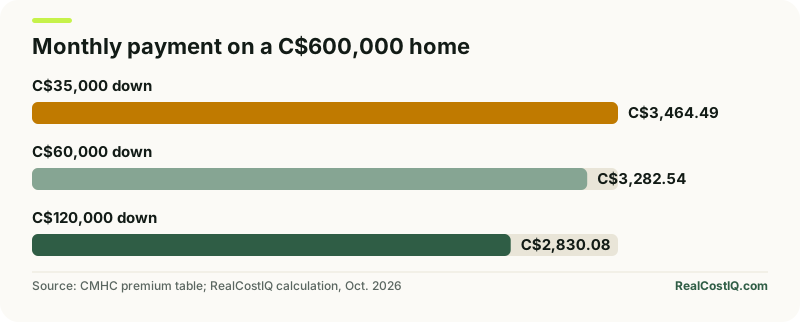
Move from the minimum to 10% down and the payment falls by C$181.95 a month (C$3,464.49 less C$3,282.54). The premium drops by C$5,860 (C$22,600 less C$16,740). Say the extra C$25,000 came from an HBP withdrawal. The repayment is C$25,000 divided by 15, which is C$1,666.67 a year, or C$138.89 a month. The payment saving of C$181.95 is bigger than the repayment of C$138.89. The net is about C$43 a month in your favour, and the premium saving comes on top. On these numbers the plan pays for itself.
Now compare 10% and 20% down. An extra C$60,000 cuts the payment by C$452.46 a month (C$3,282.54 less C$2,830.08). If all C$60,000 came from the HBP, the repayment is C$4,000 a year, or C$333.33 a month. The payment saving is larger than the repayment again, by about C$119 a month. Remember what that comparison leaves out. The repayment goes into your own RRSP, so it is not lost. The payment saving is real cash flow. And the repayment clock may not start for five years.
Rates and premium bands change this. A lower rate shrinks the payment saving. A higher rate grows it. You can test your own numbers in the CMHC insurance calculator and the down payment savings calculator.
Which should you use first?
There is no single answer, but the rules point to a sensible order for many buyers. Think of three situations.
You have RRSP savings and want to buy within a year
The HBP can be used quickly. You do not need to wait for room to build. Open an FHSA too if you have time, because each year of delay costs you C$8,000 of room that you cannot fully catch up on. Remember the 89-day rule if you are adding fresh RRSP money.
You have no RRSP and a few years to save
The FHSA is built for you. Open it as soon as you can, even with a small amount, because first-year room is C$8,000 and unused room carries forward only up to C$8,000. Waiting a year does not lose the room entirely, but waiting longer does. The FHSA also has no repayment.
You want the largest possible down payment
Use both. CRA says you can make a qualifying FHSA withdrawal for the same home as an HBP withdrawal. In theory that is C$100,000 per person, or C$200,000 for a couple, from registered accounts. CRA's rules treat the programs separately, so check each condition for each. Watch the dates too. Both programs require the home by October 1 of the year after the first withdrawal.
A note on moving money between the two. CRA says an RRSP transfer to your FHSA is not deductible and uses FHSA room. It also says you cannot count an FHSA transfer as an HBP repayment. So you cannot cycle the same dollars through both for a benefit. Treat them as two pots.
Mistakes to avoid
- Waiting to open the FHSA. Room builds from the year you open it. Opening late shortens the time to fill C$40,000.
- Withdrawing from the FHSA too early. The participation period ends after the year of your first qualifying withdrawal. Do not withdraw before you have a signed agreement.
- Treating HBP money as free. It is a loan from you to you. Budget the repayment of one-fifteenth a year.
- Missing the HBP repayment. CRA adds the shortfall to your income for that year.
- Relying on the 2031 start date without checking. The federal pages differ on whether the 2026 to 2028 relief is law. Confirm before you plan around it.
- Missing the October 1 deadline. Both programs need the home by October 1 of the year after the first withdrawal. Closing delays on a new build can push you past it.
- Using the wrong accounts. Locked-in RRSPs and group RRSPs generally do not qualify for the HBP.
What this post did not read
We did not read the CRA page on FHSA withdrawals and transfers out, because it returned an error. The qualifying-withdrawal rules above come from CRA's definitions page. We did not read the legislation. We did not model investment growth, tax brackets or tax refunds. We also did not read a forum thread from the last 12 months, because Reddit did not load for us. The C$600,000 example is hypothetical, and the 5.14% rate is an example. Your tax preparer or lender can confirm your own case.