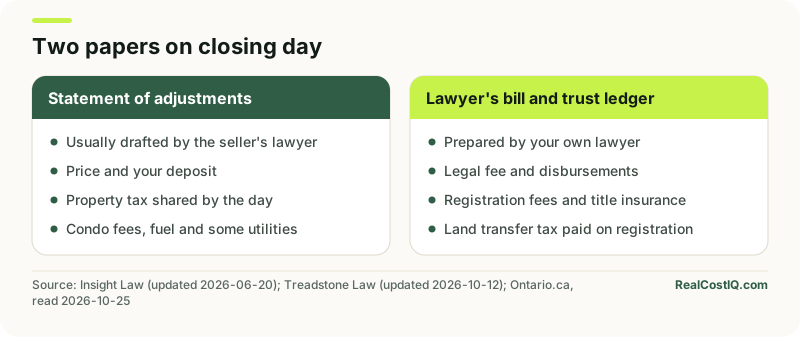
On closing day a buyer's lawyer sends two kinds of paper. One is the bill for the lawyer's own work and the money the lawyer paid out for you. The other is a sheet that settles small money matters between you and the seller, such as who pays the property tax for the days left in the year. Buyers often mix them up. Both show up as extra cash you must bring, and neither is the land transfer tax, which is the tax Ontario charges on the price of the home.
This post reads those two papers line by line. It uses one example: a C$800,000 resale house in Ontario, outside Toronto, bought with a C$600,000 mortgage. All amounts are Canadian dollars (CAD). The fee schedules and government pages were read on 2026-10-25 and are listed at the end. Lawyer fees are not set by a regulator, so every fee here is a quote from a firm's own web page, with the page's date where it had one. This is general information, not legal advice. Your own lawyer's written quote is the number that counts.
Four parts of the bill, and two different papers
Here are the four parts in plain words. The first is the legal fee. This is what the lawyer charges for the work: reading the contract, checking the title, dealing with your lender, and moving the money. The second is disbursements. A disbursement is a cost the lawyer pays to someone else for you and bills back. Searches, courier charges and title insurance are examples. The third is the government registration fee. It is paid to register your deed and your mortgage on the land title. The fourth is the statement of adjustments, which is a different kind of thing. It does not charge you for services. It shares ongoing costs of the home between you and the seller.
Land transfer tax sits beside all four. One law firm's disbursement guide says directly that land transfer tax is not a disbursement. The tax is also not a lawyer's fee. Ontario says the tax is payable when the transfer is registered. So it is collected through your lawyer on closing day, but it belongs in its own bucket.
The two papers have different jobs. Insight Law, an Ontario firm, explains it this way in a page last updated on June 20, 2026. On a resale, the seller's lawyer usually drafts the statement of adjustments. The buyer's lawyer checks it. The statement lists the price, your deposit, and shared items such as property tax. Land transfer tax, legal fees, title insurance and registration costs are buyer closing costs. The firm says they sit on the trust ledger, not in the statement of adjustments. A trust ledger is the lawyer's record of the money held for you in a trust account. Names vary by firm. Treadstone Law, another Ontario firm, says the buyer's version of the statement is sometimes called the statement of account. So when you get a paper, ask your lawyer which one it is.
A worked example: a C$800,000 Ontario house
Here are the assumptions. The buyer is not a first-time buyer, so there is no land transfer tax refund. The house is a freehold resale outside Toronto, so Toronto's own land transfer tax does not apply. The mortgage is C$600,000, which is 75% of the price. The deposit paid when the offer was accepted is C$40,000. Closing is on December 15, 2026. Property tax for the year is C$6,570, and the seller has paid all of it. The lawyer's fee and office package come from a real Ontario firm's published quote, described below. The title insurance cost of C$350 is an assumption inside the C$250 to C$500 range Ownright publishes for a purchase.
First, the round-number idea behind the property tax line. Say a home's yearly tax is C$3,650. That is C$10 a day. If you own the home for the last 20 days of the year and the seller paid the whole year, you owe the seller C$200. The formula is the same for any bill: yearly amount, divided by 365, times your days. Both Insight Law and Treadstone Law describe it this way. In the example, C$6,570 divided by 365 is C$18.00 a day. The buyer owns December 15 to December 31, which is 17 days. That is 17 times C$18.00, or C$306.00. The agreement of purchase and sale decides who owns the closing day itself. Check yours.
| Line | Buyer pays | Buyer is credited |
|---|---|---|
| Purchase price | C$800,000.00 | |
| Deposit already paid | C$40,000.00 | |
| Property tax, 17 days, seller prepaid | C$306.00 | |
| Balance due to the seller's side on closing | C$760,306.00 |
Assumes the seller has paid the full C$6,570 of 2026 property tax and that the buyer owns the closing day. A real statement may also carry condo fees, fuel in a tank, or a tenant's deposit.
Next is the lawyer's side. The legal fee and the office package come from Shaikh Law Firm, a Mississauga firm. Its fees page shows no date. It quotes C$1,100 plus HST for a purchase with one standard lender mortgage. It adds a fixed office package of C$699, with HST on top. HST is the Harmonized Sales Tax, which is 13% in Ontario. The two together are C$1,799. HST at 13% on that is C$233.87. The total is C$2,032.87. The registration fee is the government's price to register one document electronically. The Ontario land registration bulletin that takes effect on November 2, 2026 sets it at C$86.42. A purchase with a mortgage registers two documents, the transfer and the mortgage charge. That is C$172.84. Closing on December 15 falls after the change.
| Line | Amount | Where the number comes from |
|---|---|---|
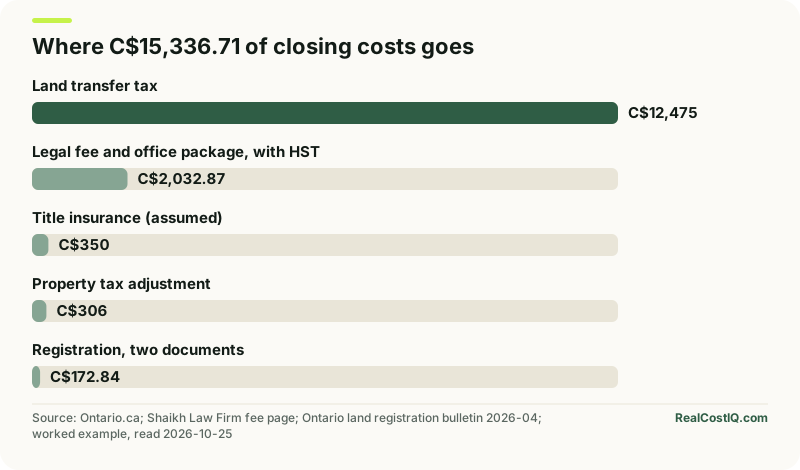
| Ontario land transfer tax on C$800,000 | C$12,475.00 | Ontario.ca rate table: C$4,475 up to C$400,000, then 2.0% of the C$400,000 above it |
| Legal fee and office package, with HST | C$2,032.87 | Shaikh Law Firm fee page: C$1,100 + C$699 + 13% HST |
| Registration of the transfer and the mortgage | C$172.84 | Ontario bulletin 2026-04: C$86.42 each from November 2, 2026 |
| Title insurance (assumed) | C$350.00 | Assumption within the C$250 to C$500 range Ownright publishes |
| Total on the lawyer's side | C$15,030.71 | Sum of the four lines above |
The C$65 Law Society levy is not in the table because the buyer buys title insurance. The levy section below explains why.
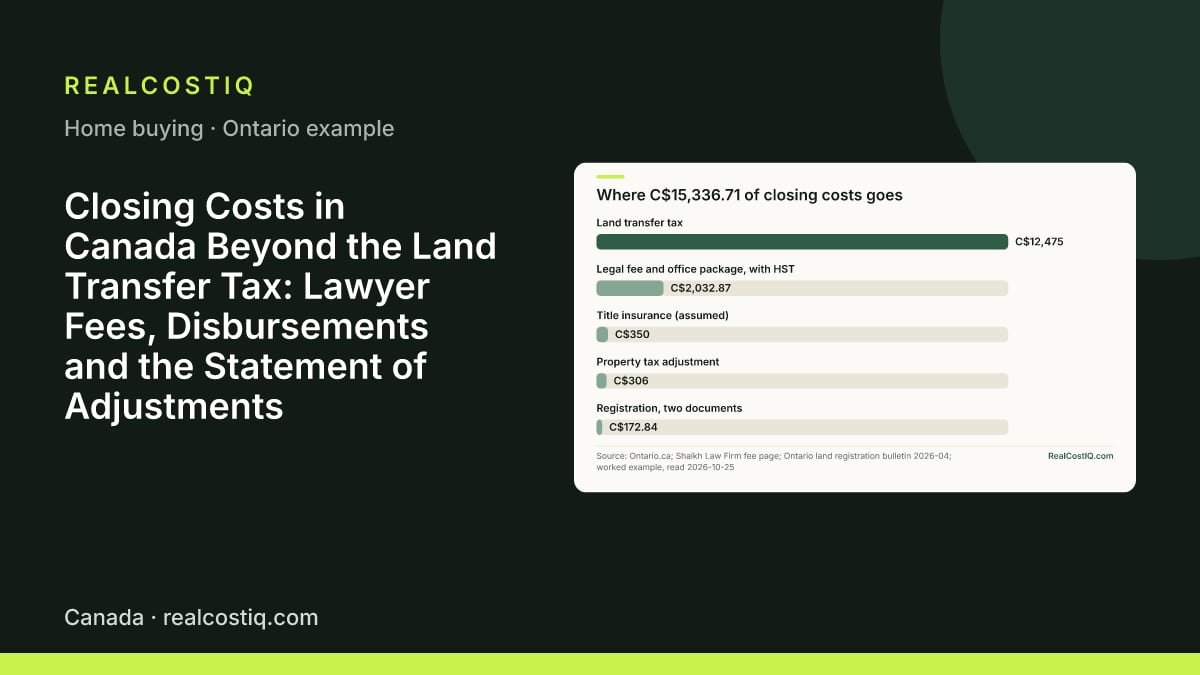
Now put them together. The lawyer's side is C$15,030.71. Add the C$306.00 property tax adjustment and the total is C$15,336.71. Of that, land transfer tax is C$12,475.00. Everything else is C$2,861.71. That is the figure the answer box rounds to C$2,862. It is made of C$2,555.71 on the lawyer's bill and C$306.00 on the statement of adjustments.
How much cash does the buyer need on closing day? The price is C$800,000. The mortgage pays C$600,000 and the deposit already covers C$40,000. That leaves C$160,000 of price. Add the C$306.00 adjustment and the C$15,030.71 on the lawyer's side. The buyer must bring C$175,336.71 at closing, on top of the deposit already paid. As a share of the price, the C$15,336.71 of costs is about 1.9%. That sits at the low end of the 1.5% to 4% range that the Canada Mortgage and Housing Corporation (CMHC) gives for closing costs. CMHC's page was published on June 5, 2020, so treat the range as a rough guide only.
Not every house sale looks like this one. A Toronto home adds the city's own land transfer tax. A first-time buyer may get a refund of up to C$4,000, according to Ontario.ca, on a page updated February 10, 2026. A condo adds a status certificate. A new build adds more lines, which a later section covers. To test your own numbers, use the Ontario closing costs calculator and the land transfer tax calculator. They model the tax. This post is about what they cannot show, which is the quote itself.
The legal fee: what a flat quote covers and what it leaves out
No regulator publishes a buyer's legal fee in Ontario. The sources below are law firm pages, so they are asking prices, not surveys. The table sets three of them side by side. The range is wide. That is useful to know before you accept the first quote.
| Page | What it says | Date on the page |
|---|---|---|
| Shaikh Law Firm, fee page | C$1,100 for a purchase with one standard lender mortgage, plus a fixed office package of C$699 | No date shown |
| Ownright, blog by its co-founder | C$750 to C$1,500 for a standard purchase in its summary; C$999 to C$1,500 with a mortgage in its table; all-in C$1,800 to C$3,000 | June 17, 2026 |
| Insight Law, statement of adjustments page | C$1,500 to C$2,500 plus HST and disbursements | Updated June 20, 2026 |
These are marketing pages from firms that sell the service. Ownright presents its ranges as typical Ontario figures. Treadstone Law's page shows two different flat fees in two places (C$1,354.87 and C$1,580.87), so we did not use either.
Look at the Shaikh quote again. The headline fee is C$1,100. The fixed office package is C$699. For every dollar of headline fee, the package adds about 64 cents. Its page says the package covers searches of the parcel register, instruments and executions, plus portal fees, identity checks, file storage, couriers and bank costs. The firm says HST applies to both parts. Third-party costs such as land transfer tax, title insurance and government fees are passed on at cost and shown on top. A buyer who only compared headline fees would think this firm cost C$1,100. The all-in legal cost was C$2,032.87 once the package and HST were added.
The same page lists extras. A second mortgage payout costs C$65 plus HST. A rush closing, where documents arrive less than seven days before closing or change in that time, costs C$450 plus HST. Non-standard work, such as private financing or a title problem, is quoted apart. These are normal kinds of extras. The lesson is to ask what triggers them. A deal that changes late is the one that costs more.
Disbursements: which lines are the same everywhere
Some disbursements are set by a government and are the same for every buyer. Others depend on the firm. Wannes Law, an Ontario firm, published a disbursement guide on September 18, 2026. It estimates a standard purchase with one mortgage at about C$650 to C$1,000 plus HST, with title insurance on top. It calls out which lines are firm-specific. Its list shows how wide the choices are.
| Line | Amount quoted | Set by |
|---|---|---|
| Land registration, per document | C$85.00 until November 1, 2026 | Government |
| Parcel register (title search), per parcel | C$36.50 | Government |
| Writ (execution) search, per name | C$13.10 to C$17.17 | Government |
| Tax certificate | C$60 to C$100 | Municipality |
| Condo status certificate | Capped at C$100 including taxes, unless rush or online fees apply | Condo corporation |
| Closing software fee | C$100 to C$300 | Firm |
| Identity verification | C$25 to C$40 | Firm and its provider |
| Wires and bank drafts | C$25 to C$100 | Firm and its bank |
| Couriers and registered mail | C$25 to C$75 | Firm |
Ownright's June 17, 2026 page gives different ranges for the firm lines: software C$50 to C$150, identity checks C$20 to C$50 and wires C$15 to C$45. The ranges differ because firms differ. Ask for the actual line items.
The government lines are exact. Ontario publishes them in a land services fee bulletin. Bulletin 2025-07 set an electronic registration at C$85.00 from November 3, 2025. That total is C$71.55 statutory fee, C$11.90 for the electronic service and C$1.55 HST. Bulletin 2026-04 was published on September 14, 2026. It takes effect on November 2, 2026. It lifts the electronic registration to C$86.42, a parcel register copy to C$37.10, and a search for writs under a key enforcement office to C$13.30. So the date you close matters by a few dollars. A closing on or after November 2 pays the new schedule.
The C$65 Law Society levy shows up only on some files
Some bills carry a Law Society of Ontario transaction levy. The Lawyers' Professional Indemnity Company (LAWPRO) explains it on a public page. The levy is C$65 per transaction and includes provincial sales tax. It is not subject to HST. It applies generally when the lawyer acts only for the seller, or for a buyer who has not bought title insurance. If every buyer and lender on the file has title insurance, it does not apply. LAWPRO says the levy rises to C$100 on files opened on or after January 1, 2027. So the levy is not a fee for you to haggle over. It is a sign of whether title insurance is on the file. The post on title insurance and a lawyer's title search covers what the policy does and does not pay for.
HST: which lines carry it
Ownright says 13% HST applies to the lawyer's fee and most disbursements. It says land registration fees and land transfer tax are not subject to HST. The government bulletin adds one detail. HST applies only to the electronic-service part of the registration fee, which is C$1.57 from November 2, 2026, and that is already inside the C$86.42 total (it was C$1.55 inside C$85.00 before). Wannes Law flags the exceptions and says the lawyer's statement of account will show which lines carry HST. So read the HST column on your own bill.
Land transfer tax: the big line, in one paragraph
Using Ontario's rates on Ontario.ca (updated April 22, 2026), the provincial tax on a C$800,000 home is C$12,475. A first-time buyer who qualifies can get a refund of up to C$4,000. Toronto adds its own tax on top. This post stops here because the calculators above handle the rest.
Reading the statement of adjustments, line by line
A statement of adjustments answers one question. Who should pay for each day of an ongoing bill? Ontario law firms list the same core lines. Insight Law's page and Treadstone Law's page agree on most of them. Here is what each line means and what to check.
- Purchase price and deposit. The price is a debit to you. Your deposit is a credit. Check that the deposit matches what you paid. Insight Law lists this as the first line.
- Property tax. If the seller prepaid, you pay the seller back for your days. If tax is owing, the seller credits you. Insight Law says the lawyer orders a tax certificate from the municipality, which shows what is paid and what is owed. Insight Law lists a mistake: assuming tax is paid when an instalment is still due.
- Condo fees. These work the same way as property tax by the day. The status certificate confirms the monthly fee and any special assessment. A special assessment is a one-time charge to owners for a large repair.
- Utilities. Practice differs. Insight Law says utilities are adjusted to the meter reading or final bill. Treadstone Law advises sellers to settle accounts in their own names. Ask your lawyer which way your file goes.
- Fuel left in the tank. Oil or propane left in a tank is a credit to the seller, according to Insight Law.
- Rent and a tenant's deposit. For a home with a tenant, rent collected for days after closing and the last-month deposit with interest are credits to the buyer. A forgotten tenant deposit is on Insight Law's list of common errors.
- HST on a new build. A new home carries HST, and the builder's rebate claim shows up on the statement. A later section covers this.
Timing matters. Both law firms say the statement usually arrives a few days before closing. Insight Law lists reading it for the first time at the signing table as a common error. A better habit is to ask your lawyer for a draft as early as possible. Then check three things. Is the closing date right? Is the deposit right? Does the property tax figure match the tax certificate? A wrong closing date changes every daily line.
Here is a small change that shows why the date matters. Suppose closing slides from December 15 to December 22. The buyer now owns 10 days of the year, not 17. The property tax line falls from C$306.00 to C$180.00. That is 10 times C$18.00. The price and all fees stay the same. The buyer's cash falls by C$126.00. The seller's side rises by the same amount. The money did not vanish. It moved to the person who owned the house for those extra days.
New builds change the statement
For a newly built home, the builder's lawyer prepares the statement and your lawyer reviews it. Insight Law lists extra lines that can appear: HST and the builder's handling of the new housing rebate, development charges passed to buyers, Tarion enrolment and utility hookups, and an interim occupancy fee before the building is registered. Tarion is Ontario's new-home warranty program. Development charges are fees a municipality sets on new construction. Insight Law warns that development charges can run from a few thousand dollars to tens of thousands if the agreement does not cap them. The firm lists leaving those charges uncapped in the agreement as a common error. This is where a new build bill can look very different from the resale example above. Use the Canadian closing costs calculator as a starting point, then ask the builder's lawyer for the full list.
How Alberta and British Columbia differ
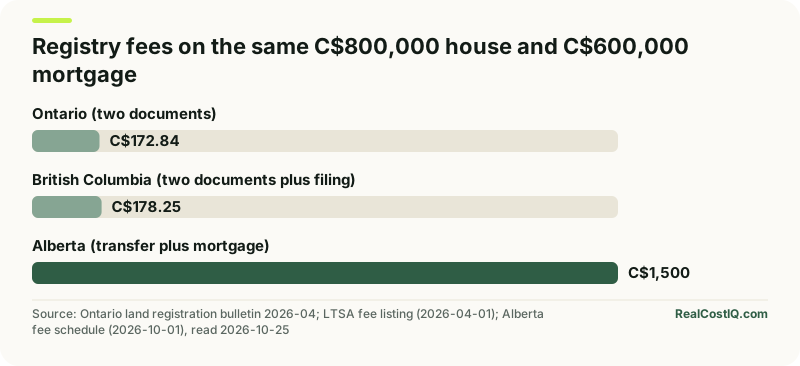
The idea of a lawyer's fee plus disbursements plus adjustments is the same across Canada, outside Quebec, where a notary handles the transfer. What changes is the government fee and the tax. The Alberta government pages read for this post show a registration fee on a sliding scale, and no land transfer tax. The Alberta fee schedule says that for submissions received on or after October 1, 2026, a transfer of land costs C$50 plus C$5 for each C$5,000 of value. A mortgage costs C$50 plus C$5 for each C$5,000 of the principal. On the example house, the transfer is C$50 plus 160 steps of C$5, or C$850. The C$600,000 mortgage is C$50 plus 120 steps of C$5, or C$650. Together that is C$1,500. Alberta's registration page says the scale was C$2 per C$5,000 for transfers and C$1.50 for mortgages until a levy raised it to C$5 for submissions received on or after October 20, 2024.
British Columbia's registry is the Land Title and Survey Authority (LTSA). Its customer fee listing as at April 1, 2026 shows C$83.82 to register a transfer of title and C$83.82 to register a mortgage. It also shows C$10.61 to file a transparency declaration. For the example, two registrations and one filing come to C$178.25. British Columbia then has its own property transfer tax, which is a separate tax from these fees. The BC and Alberta closing costs calculators on this site model each province in full.
Questions to ask before you hire a lawyer
A good quote lets you compare. Ask for it in writing. Then check it against this list.
- What is the all-in price before HST, with every fixed fee included? Ask for the number you will pay if nothing unusual happens.
- Which items are disbursements, and what is each one? Ask for the software fee, identity check, wires, couriers and searches by line.
- Is title insurance included? If it is not, will the C$65 levy appear on the bill?
- What would make the price go up? Rush closing, a second mortgage payout or a title problem are common triggers.
- Will the lawyer send a draft statement of adjustments, and how early? Ask for it at least a few days before closing.
- Which date will the closing be, and who owns the closing day? That sets every daily line.
- For a condo, who orders the status certificate, and what does it cost? For a new build, what development charges and Tarion lines will be on the statement?
What this post did not read
The Law Society of Ontario's By-Law 6 page returned an access error on the day of reading, so the levy figures come from LAWPRO's public page. No regulator publishes a buyer's legal fee, so the fee figures are firm quotes. We also tried the RedFlagDeals threads on lawyer fees. The site redirected to a paywalled copy, so we did not use them. The Ontario rates and fees above were read on the pages named in the sources list. Fees and rates can change. Check the date on the page you rely on.