A C$1 million home is no longer a rare price. The Toronto Regional Real Estate Board (TRREB) said the average selling price in the Greater Toronto Area was C$1,006,409 in September 2026. Many buyers now ask the same thing. Can I still buy with less than 20% down? The answer is yes, and the old C$1 million limit is gone. This post works one C$1 million purchase through in Canadian dollars (CAD), with round numbers, step by step.
In plain English
- A mortgage is a loan to buy a home. The down payment is the cash you pay up front. The mortgage covers the rest.
- The minimum down payment on C$1 million is C$75,000. That is 5% of the first C$500,000 plus 10% of the remaining C$500,000.
- With less than 20% down, the mortgage must be insured. You pay a one-time premium to the Canada Mortgage and Housing Corporation (CMHC) or another insurer. It protects the lender, not you.
- Since December 15, 2024, a home can be insured if it costs less than C$1.5 million. Before that, the limit was C$1 million.
- At an example rate of 5.14% over 25 years, the payment is about C$5,672 a month with the minimum down and about C$4,717 with 20% down. The difference is the CMHC premium.
- Lenders also test whether you could pay at a higher rate. That test sets the income you need, and it is higher than most people expect.
One worked example: C$1,000,000 with the minimum down
Start with the simplest case. You buy a C$1,000,000 home and put down the least the rules allow. Here is each step.
- Find the minimum down payment. The Financial Consumer Agency of Canada (FCAC) says homes from C$500,000 up to C$1.5 million need 5% of the first C$500,000 plus 10% of the rest. That is C$25,000 plus C$50,000, or C$75,000. It is 7.5% of the price.
- Find the loan before insurance. C$1,000,000 minus C$75,000 is C$925,000.
- Find the loan-to-value. This is the loan divided by the price. C$925,000 divided by C$1,000,000 is 92.5%.
- Look up the CMHC premium. CMHC's premium table says a loan-to-value from 90.01% to 95% costs 4.00% of the total loan. 4.00% of C$925,000 is C$37,000.
- Add the premium to the loan. C$925,000 plus C$37,000 is C$962,000. You can add the premium to the mortgage, so you do not pay it up front.
- Pick a rate. We use 5.14% as an example. It is the Royal Bank of Canada (RBC) advertised five-year fixed special, read on 2026-10-27. It is not a quote. RBC also lists a lower 4.84% special for insured mortgages, but its page limits that rate to homes valued under C$1,000,000, so it does not apply to a C$1,000,000 purchase. Ask your lender which rate applies at your price.
- Pick the amortization. We use 25 years. Amortization is the total time to repay the whole loan. It is not the same as the term, which is the length of one contract, often five years.
- Work out the payment. The result is about C$5,671.96 a month. In Canada, fixed-rate mortgages compound twice a year (semi-annually), not monthly. The numbers here use that method.
That is principal and interest only. Principal is the money you borrowed. In the first month, about C$4,077 of the payment is interest and about C$1,595 reduces the loan.
Now add the costs of owning the home. We use two placeholders. The first is property tax. The City of Toronto's 2026 residential tax rate is 0.767311% (City of Toronto, property tax rates and fees, read 2026-10-27). If the home were assessed at C$1,000,000, that is about C$7,673 a year, or C$639 a month. In real life the tax is based on the assessed value, which can differ from the price, so use the number on the listing. The second is heat, at C$150 a month. These are not averages. They are there so the total looks like a real budget.
| Item | Amount (CAD) |
|---|---|
| Mortgage principal and interest | C$5,671.96 |
| Property tax (2026 Toronto rate, assessed at the price) | C$639.43 |
| Heat (placeholder) | C$150.00 |
| Total per month | C$6,461.39 |
Hypothetical. Mortgage worked out with semi-annual compounding on C$962,000. Home insurance, other utilities, condo fees and maintenance are not included. The provincial sales tax on the premium (see below) is paid in cash.
The C$1.5 million cap, and why the old C$1 million limit is out of date
Many web pages still say that a home of C$1 million or more needs 20% down. That was true until December 14, 2024. The Department of Finance said the price cap for insured mortgages rose from C$1 million to C$1.5 million on December 15, 2024 (Finance Canada, news release, read 2026-10-27). CMHC's requirements page now says the price must be below C$1,500,000 for a homeowner loan (CMHC, general requirements, read 2026-10-27).
One sentence on the FCAC down-payment page, read the same day, still mentions a C$1 million limit. Its own table on the same page uses C$1.5 million. When two government pages disagree, follow the one that runs the insurance. That is CMHC.
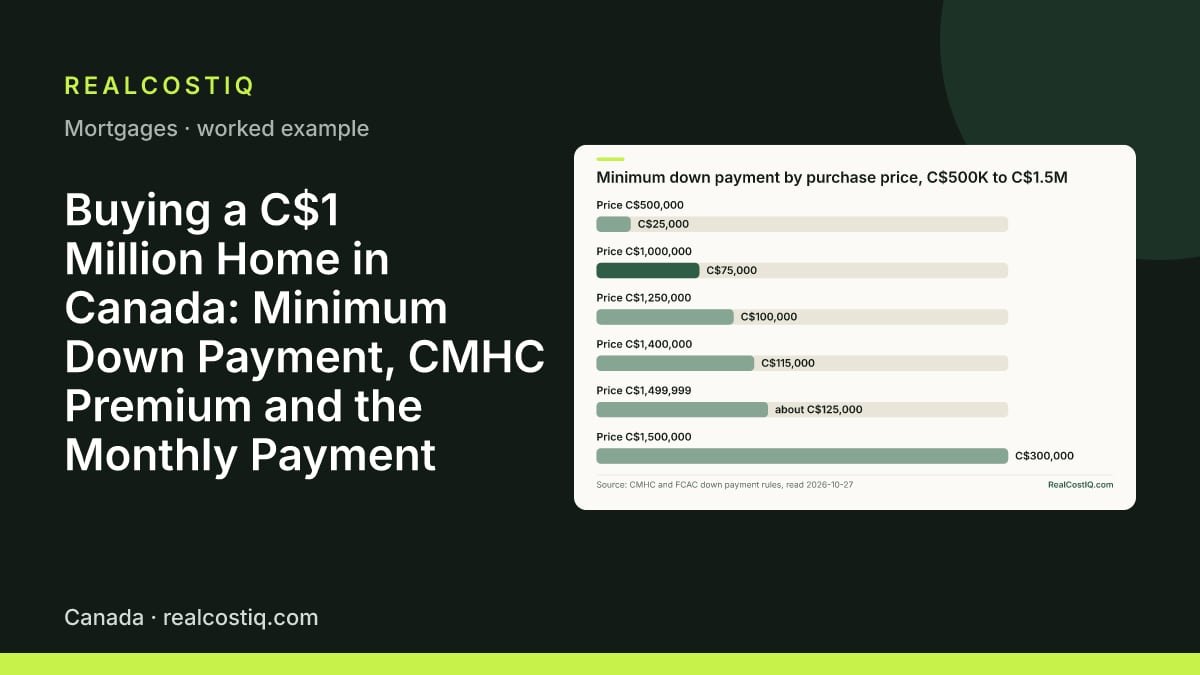
The minimum down payment does not rise smoothly as the price rises. It rises in a straight line up to C$1,499,999, then jumps. At C$1.5 million or more you need 20%. The table shows the jump.
| Purchase price | Minimum down payment | Share of price |
|---|---|---|
| C$500,000 | C$25,000 | 5.0% |
| C$1,000,000 | C$75,000 | 7.5% |
| C$1,250,000 | C$100,000 | 8.0% |
| C$1,400,000 | C$115,000 | 8.2% |
| C$1,499,999 | about C$125,000 | 8.3% |
| C$1,500,000 | C$300,000 | 20.0% |
The formula is 5% of the first C$500,000 plus 10% of the rest, up to a price below C$1.5 million. At C$1.5 million or more the minimum is 20% of the price. Finance Canada's own C$1.4 million example is C$165,000 lower than a 20% down payment, which matches: C$280,000 minus C$115,000.

So a buyer at C$1,499,000 needs about C$125,000 down. A buyer at C$1,500,000 needs C$300,000. That is about C$175,000 more for a price that is C$1,000 higher. If you are near the line, price is a cliff, not a slope.
The same home with 10% and 20% down
Now compare three down payments on the same C$1,000,000 home. All use 25 years and the same example rate of 5.14%, so the premium is the only thing that changes the cost. In real life, lenders often price insured and uninsured mortgages differently, and the insured special that RBC lists is not open at this price. Ask for both quotes.
| Minimum down (7.5%) | 10% down | 20% down | |
|---|---|---|---|
| Down payment | C$75,000 | C$100,000 | C$200,000 |
| Loan before insurance | C$925,000 | C$900,000 | C$800,000 |
| Loan-to-value | 92.5% | 90.0% | 80.0% |
| CMHC premium rate | 4.00% | 3.10% | None |
| Premium added to loan | C$37,000 | C$27,900 | C$0 |
| Total mortgage | C$962,000 | C$927,900 | C$800,000 |
| Example rate | 5.14% | 5.14% | 5.14% |
| Monthly payment | C$5,671.96 | C$5,470.90 | C$4,716.80 |
| Plus tax and heat placeholders | C$6,461.39 | C$6,260.33 | C$5,506.23 |
Hypothetical. Premium rates are from CMHC's premium table (read 2026-10-27). The rate is RBC's advertised five-year fixed special read the same day, not a quote. Payments use semi-annual compounding. The provincial sales tax on the premium is paid in cash and is not in these numbers.

Look at the first two columns. Putting down C$25,000 more cuts the payment by about C$201 a month. The loan is smaller, and the premium rate drops from 4.00% to 3.10%. CMHC's table steps down at exactly 90% loan-to-value. A 10% down payment sits right on that step.
The jump to 20% down is bigger. You borrow C$800,000 and pay no premium. The payment falls to about C$4,717, or about C$955 a month less than the minimum. At the same rate, the premium is the whole reason. Whether it pays to save longer to reach 20% is a separate question. Our post on 20% down or paying CMHC insurance works through the break-even.
You can test any price and rate yourself. The CMHC insurance calculator shows the premium for your down payment. The mortgage calculator gives the payment using the same semi-annual method.
What the premium really costs, and the tax on it
The premium is not small at this price. On the minimum-down case it is C$37,000. You do not pay it up front, because it is added to the loan. But you pay interest on it for as long as you owe it.
There is a second cost that is not added to the loan. CMHC says premiums in Ontario, Quebec and Saskatchewan are subject to provincial sales tax, and that this tax cannot be added to the loan amount (CMHC, mortgage loan insurance cost, read 2026-10-27). You pay it in cash at closing. The Ontario retail sales tax rate on insurance premiums is 8% (Ontario Ministry of Finance, insurance and benefits plans, read 2026-10-27). That page did not address mortgage insurance directly, so ask your lender to confirm the tax in dollars. If 8% applies, the minimum-down case owes about C$2,960 in cash (8% of C$37,000). The 10% down case owes about C$2,232 (8% of C$27,900).
This is why a quote from a lender should list the premium, the tax and the total mortgage as three lines. If it lists only one number, ask for the other two.
The income you need: the stress test
A lender does not decide on your actual payment. It tests whether you could pay at a higher rate. This is called the stress test. For insured mortgages, CMHC says the qualifying rate is the higher of your contract rate plus 2 percentage points or 5.25% (CMHC, calculating GDS and TDS, read 2026-10-27). The Office of the Superintendent of Financial Institutions (OSFI) sets the same rule for uninsured mortgages at federally regulated lenders (OSFI, minimum qualifying rate page, last modified 2026-01-29).
CMHC also caps two ratios. The gross debt service ratio (GDS) is housing costs divided by gross income. It is capped at 39%. The total debt service ratio (TDS) adds your other debts, such as a car loan. It is capped at 44%. Housing costs here are the mortgage payment, property tax, heat and half of any condo fees. We assume no other debts, so GDS is the limit that bites.
Take the minimum-down case. The contract rate is 5.14%, so the qualifying rate is 7.14%. The payment on C$962,000 at 7.14% is about C$6,821 a month. Add C$639 of tax and C$150 of heat, and housing costs are about C$7,611. Divide by 0.39 and the household needs about C$19,515 a month in gross income. That is about C$234,178 a year.
| Minimum down | 10% down | 20% down | |
|---|---|---|---|
| Contract rate | 5.14% | 5.14% | 5.14% |
| Qualifying rate (higher of +2 points or 5.25%) | 7.14% | 7.14% | 7.14% |
| Payment at the qualifying rate | C$6,821.36 | C$6,579.56 | C$5,672.65 |
| Plus tax and heat placeholders | C$789.43 | C$789.43 | C$789.43 |
| Gross income needed per year | C$234,178 | C$226,738 | C$198,833 |
Hypothetical. The 39% limit is CMHC's GDS cap for insured loans. For the 20% down column it is used for comparison only: an uninsured lender sets its own ratios. Property tax assumes an assessed value equal to the price. Other debts would raise the income needed.
Two things stand out. First, the income needed is far above what many buyers earn in a year. That is why a C$1 million home is often bought by two earners. Second, more down payment lowers the income needed. At 20% down, the household needs about C$198,833, which is about C$35,345 less than at the minimum.
The Bank of Canada's policy rate is 2.25%, and its next decision is October 28, 2026 (Bank of Canada, key interest rate page, read 2026-10-27). A lender's rate and the qualifying rate can move with it. Re-run the numbers on the day you apply. Do not rely on the example here.
The cash you need on closing day
The down payment is not the only cash. In Ontario you also pay land transfer tax. In Toronto you pay a second one, the municipal land transfer tax, so a Toronto buyer pays two. We use the same brackets for both on a C$1,000,000 home.
- Ontario land transfer tax. 0.5% to C$55,000, 1.0% to C$250,000, 1.5% to C$400,000, and 2.0% to C$2,000,000 (Ontario, calculating land transfer tax, read 2026-10-27). On C$1,000,000 that is C$275 plus C$1,950 plus C$2,250 plus C$12,000, or C$16,475.
- Toronto municipal land transfer tax. The City of Toronto uses the same brackets up to C$2,000,000 (City of Toronto, MLTT rates, page modified 2026-04-07). On C$1,000,000 that is another C$16,475.
- First-time buyer refunds. Ontario refunds up to C$4,000 and Toronto up to C$4,475, for a first-time buyer who will live in the home (Ontario refund page and City of Toronto rebate page, read 2026-10-27). That is C$8,475 off the C$32,950 combined tax, for a net of C$24,475. If you have owned a home before, the full C$32,950 applies.
| Item | Amount (CAD) |
|---|---|
| Down payment | C$75,000 |
| Ontario land transfer tax | C$16,475 |
| Toronto municipal land transfer tax | C$16,475 |
| Provincial sales tax on the premium (if 8%) | C$2,960 |
| Total before refunds | C$110,910 |
| Less first-time buyer refunds (C$4,000 + C$4,475) | -C$8,475 |
| Total for a first-time buyer | C$102,435 |
Hypothetical. Excludes legal fees, title insurance, inspection, moving costs and tax or utility adjustments. Ask your lawyer whether the refunds come off at closing or are claimed afterwards. Outside Toronto there is no second land transfer tax in Ontario. Other provinces use other rules, so use the land transfer tax calculator.
So the real cash target for the minimum-down purchase is about C$102,000 to C$111,000, not C$75,000. The extra C$27,000 to C$36,000 catches many buyers by surprise.
What happens at the end of the term
Most Canadian mortgages have a five-year term. At the end of the term you renew at the rate then on offer, even though the amortization is 25 years. If you hold the rate the same, the balance after five years is about C$853,304 with the minimum down, about C$823,057 with 10% down and about C$709,608 with 20% down.
A real renewal will not be at the same rate. To see the risk, add one percentage point to each example rate for the full 25 years. The payment would be about C$6,235 at the minimum down, C$6,014 at 10% down and C$5,185 at 20% down. That is about C$563, C$543 and C$468 a month more than the base case. A one-point move on a mortgage this large is a real change to the budget. The stress test exists for this reason.
A short plan for a C$1 million purchase
- Check the price against the cap. If the price is C$1,500,000 or more, plan for 20% down. If it is below, the 5% and 10% rule applies.
- Work out the minimum down. Use 5% of the first C$500,000 plus 10% of the rest.
- Ask for the premium in dollars. Ask for the premium, the provincial sales tax on it and the total mortgage as separate lines.
- Get two quotes at the same price. One insured and one uninsured, so you can see the real gap.
- Add the closing cash. Land transfer tax, any municipal tax and legal costs come on top of the down payment.
- Test a higher rate. Add one point to the rate and see whether you still pass the stress test and the budget.